
A buyer stands in front of two cars. The electric one costs noticeably more, so they walk away – perfectly reasonable, at first glance. But they have just made the decision based on the one number that says the least about what the car will actually cost them. The price on the windscreen is the entry ticket, not the whole bill.
That whole bill has a name: TCO – Total Cost of Ownership. It adds up everything a vehicle costs over its entire life, not just the moment of purchase. And only once everything is added up does the picture sometimes turn completely upside down.
What TCO Actually Includes
The purchase price is only the first term. Alongside it come the cost of energy (electricity or fuel) across every kilometer driven, maintenance and servicing, insurance, taxes and incentives, and the loss of the vehicle’s value over the years. Some of these costs fall once; others drip in every month and every kilometer – and it is precisely those “dripping” costs, invisible at purchase, that often tip the balance in the end.
An electric vehicle typically starts with a higher purchase price but lower running costs. The entire TCO story comes down to this: whether the lower running costs, over enough kilometers, manage to make up for the higher initial price.
Where the Electric Vehicle Wins
Two costs are systematically on the side of electricity. The first is energy per kilometer: charging is, as a rule, noticeably cheaper per kilometer driven than fuel, and the more you drive, the larger that difference grows in absolute terms.
The second is maintenance. An electric drivetrain has dramatically fewer moving parts – no oil to change, none of the host of wearing components of a conventional engine, and regenerative braking spares the brakes too. Fewer parts mean fewer failures and fewer service visits, which over the years turns into real savings.
But – Where You Charge Changes Everything
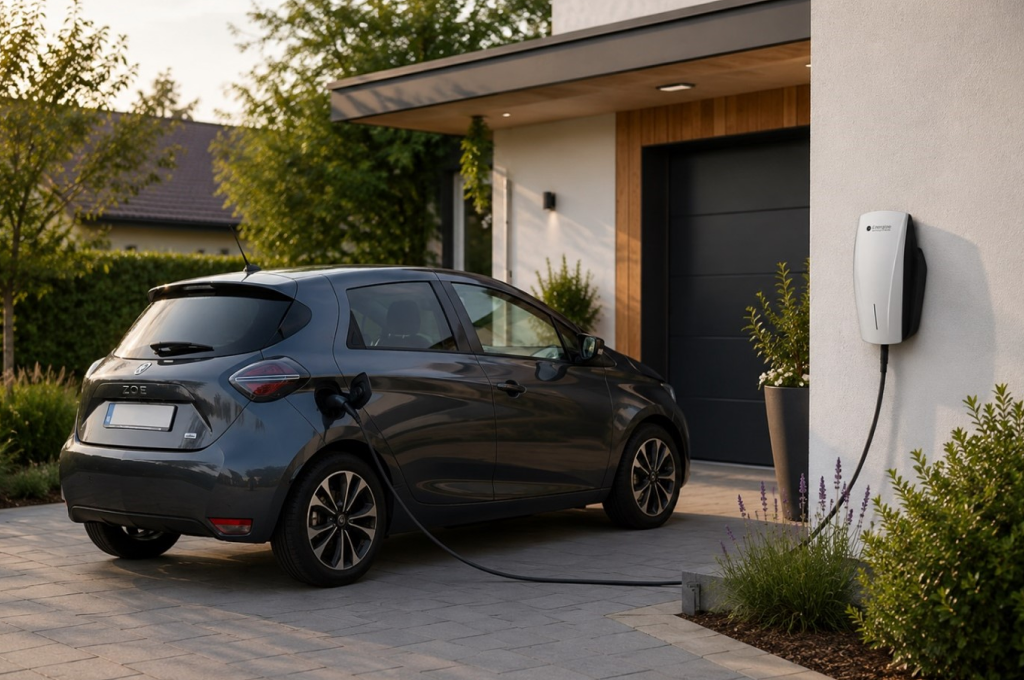
Here comes the nuance that marketing happily skips. “Cheaper charging” is not a single price, but a range. Charging at home or at a depot, especially on a lower night tariff, is the cheapest, and it is what carries the bulk of the TCO advantage. Public DC fast charging, on the other hand, can be several times more expensive – sometimes enough to approach the cost of fuel.
In other words, the saving is not an automatic property of the vehicle, but a consequence of charging strategy. A driver who relies mostly on expensive public charging spends much of what they would otherwise have saved. That is why the real question is not only “electric or not,” but also “where and how will I charge” – and this is where infrastructure stops being a cost and becomes the very thing that unlocks the saving.
The Tipping Point
TCO is most easily understood through a single image: the higher initial price and the lower running costs intersect at some point. Before it, the electric vehicle is more expensive; after it, cheaper – and ever cheaper the further you drive.
This is why the math is most convincing where the kilometers are many: with fleets, delivery vehicles, taxis, anyone who uses a vehicle intensively. They reach that tipping point quickly, so the higher purchase price returns to them and turns into a clear saving. For a driver who covers few kilometers, especially while relying on expensive public charging, the tipping point may come late or not at all.
What to Watch For
TCO is not a universal verdict, but a calculation done for a specific case. It is strongly influenced by the ratio between electricity and fuel prices (which differs from country to country), local incentives and taxes, and the vehicle’s residual value, which is still less predictable than with conventional cars. That is why TCO should not be taken as a ready-made figure, but calculated for a given market, driving profile, and charging method.
Conclusion
The cheapest car to buy and the cheapest car to own are rarely the same car. The price on the windscreen answers the wrong question.
The right question is not “how much does it cost to buy,” but “how much does it cost to drive over its entire life, the way I actually drive and charge it.” The answer to that question often lies exactly where no one looks – in the running costs, and in where the vehicle is charged.