The Wrong Question
“What is better, hydrogen or batteries?” is perhaps the most frequently asked question in the energy transition. And one of the most misguided.
Asking which is “better” is like asking whether it is better to use a fork or a knife for eating. The answer depends on what you are eating. Hydrogen and batteries are not competitors — they are two entirely different tools for two entirely different problems. A manager who understands this saves millions. One who does not — builds the wrong infrastructure.
Time Scales: Hours vs. Months
The most important difference is not in technology but in time.
Batteries excel at storing energy for minutes to a few hours. A lithium-ion system can absorb excess solar power at 1:00 PM and deliver it at 7:00 PM when household demand spikes. They do this very efficiently — with round-trip efficiency of 85–95%.
But try storing summer solar energy in batteries for winter heating. The cost becomes astronomical, and self-discharge over time becomes unbearable. Seasonal storage in batteries simply makes no economic sense.
Hydrogen tells the opposite story. Round-trip efficiency is only 30–40%, which is objectively poor. But once produced and compressed, hydrogen can be stored for months or years in tanks or underground formations without significant loss. The summer surplus becomes winter feedstock.
Energy Density and Mobility
The second key difference is mass.
An electric truck with 800 km of range carries about 5 tons of batteries. A hydrogen truck with the same range carries roughly 60 kg of hydrogen in tanks. The difference in payload capacity is dramatic — and for logistics companies, that is a direct hit to profit per ton transported.
For passenger vehicles, this difference is irrelevant. For 40-ton trucks, ships, and aircraft, it is existential. That is why Tesla makes cars and Hyundai and Daimler invest heavily in FCEV trucks.
Cost per kWh of Storage
For energy storage of up to 4 hours, lithium-ion batteries are unbeatable on cost — below EUR 200 per kWh of capacity. For storage longer than a week, batteries become uneconomic, and hydrogen becomes cheaper per kWh stored (even though it loses on efficiency).
Rule of thumb: if you need to shift energy in time within the same day or week — batteries. If you need to shift it across months or transport it across borders — hydrogen.
Synergy, Not Competition
The smartest European projects do not choose one or the other. They build hybrids.
A 100 MW solar park in Vojvodina could have:
- A 50 MWh BESS for daily fluctuations and grid balancing services
- A 20 MW electrolyzer to absorb midday surplus and produce hydrogen for local industry
- A grid connection to sell power when prices spike
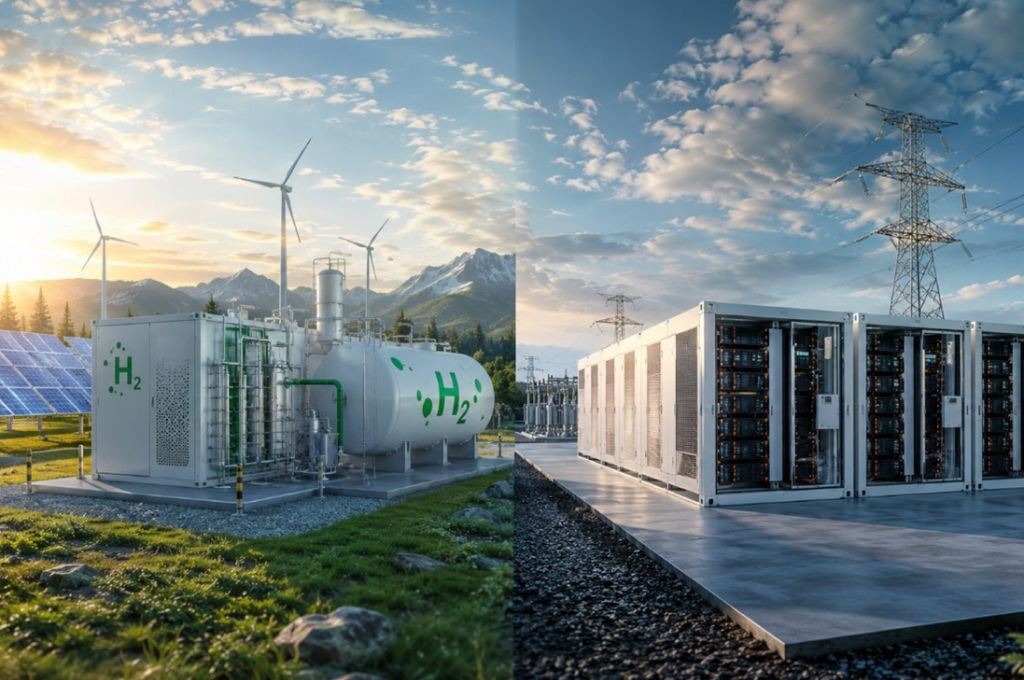
Three systems, three functions, one economy. Batteries and hydrogen do not compete — they cover different parts of the load duration curve.
What This Means for the Serbian Market
The Serbian BESS market is taking off — projects of several hundred MWh are already in various development stages. Hydrogen is just arriving. The biggest mistake investors make is treating these two technologies as alternatives.
For a solar park being offered for sale, the key question for a potential investor is: does the infrastructure leave room for future hydrogen integration? H2-ready design costs very little extra today and opens an option that in 5–7 years could be the most valuable part of the project.
For industrial buyers, the question is not “batteries or hydrogen.” The question is: how much energy do you need as electricity (batteries and grid), and how much as molecules (hydrogen) for processes that cannot be electrified.
The energy transition is not a “victory of batteries over hydrogen” or vice versa. There are enough room for both tools, and too many different problems to be solved by just one solution.