Energy audits of commercial buildings keep producing the same finding, often enough that it has become a rule of the trade: the largest savings usually come not from new equipment but from changing how the existing equipment runs. The U.S. national laboratory PNNL estimates that 10 to 30 percent of the energy used in commercial buildings is wasted through improper and inefficient operation, conditioning empty rooms, heating and cooling fighting each other in the same zone, schedules that ignore how the building is actually used. Nobody approved those kilowatt-hours; they are the product of a system that runs but is not managed.
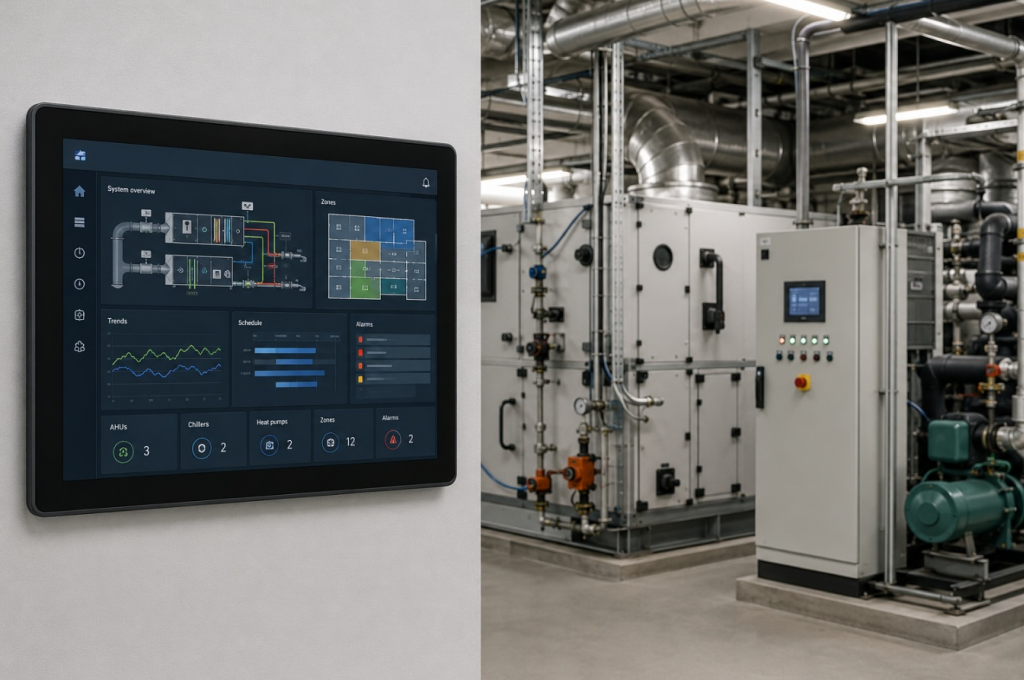
The tool that closes this gap is controls. A BMS (Building Management System) is the central system that monitors and manages a building’s technical installations: it connects chillers, heat pumps, air handling units, and individual zones into a whole governed by rules rather than by user habit. The relationship between equipment and controls fits into one sentence: equipment determines what a system can do, and controls determine what it actually does.
Double-digit savings often require no new equipment
Most of the waste is removed by measures that leave every machine untouched. Operating schedules are aligned with actual use, so the building stops being conditioned on Sunday as if it were Tuesday. Temperature setpoints are reviewed and separated, so heating and cooling stop overlapping in the same zones. Start-up is optimized so the building reaches the required temperature just before people arrive instead of starting flat at five in the morning, and shutdown begins before closing time, because the building’s thermal inertia carries comfort for another hour.
A separate source of savings is free cooling. Cooling with outdoor air whenever its temperature and humidity are low enough. In transition seasons and at night, many buildings can reject heat practically for free, but only if the controls recognize the right conditions and open dampers before starting compressors. In server rooms and technical spaces the same logic applies through most of the year.
That this is not theory is shown by an analysis of operational optimization projects in some 1,500 North American buildings published by the national laboratory LBNL: nearly all implemented measures were control measures, schedules, setpoints, and operating sequences, and the typical payback period was under two years. In practice, systematic tuning of this kind is followed by savings of 10 to 20 percent, without a single new machine in the plant room.
A BMS turns scattered equipment into one system
Without a central system, a large building is run through dozens of thermostats and remote controllers, and the operating mode depends on who last walked into the room. A BMS gathers that diluted control in one place. The operator sees temperatures, modes, and consumption for every zone, sets schedules by zone and day type, receives an alarm the moment something deviates, and has months of trend data for every measured value.
The value grows with the scope of integration. When the same system runs HVAC and lighting and tracks energy metering by area, the building stops being a sum of independent installations: lighting and air conditioning follow the same schedule, consumption is attributed to specific consumers, and decisions rest on measured rather than assumed conditions. At that level, controls stop being an accessory to the mechanical plant and become the building’s management layer.
Consumption trends reveal failures before occupants report them
The data a BMS records has diagnostic value as well. Consumption that climbs week after week with no change in weather or use almost always means degradation: a fouled heat exchanger, a clogged filter, refrigerant loss. Nighttime consumption in a building that does not operate at night means some system is running outside its schedule. A zone that constantly calls for cooling while its neighbors sit idle points to a failed sensor, a leaking valve, or an internal gain the design never anticipated.
Occupants report none of this, because comfort is not yet affected, it will be once the degradation has advanced far enough, usually in mid-season, when the system is under the highest load and service crews are busiest. Trends and alarms move detection forward: the problem shows up in the data weeks before it becomes an outage, so the intervention is planned around the actual condition of the equipment rather than the calendar or the breakdown.
Remote monitoring runs dozens of sites from a single center
For owners of multiple properties, retail chains, bank networks, office portfolios, controls also change the organization of management itself. Instead of each location depending on the presence and judgment of local staff, everything is monitored from one center: the same rules, the same setpoints, the same response to an alarm. Local improvisations, such as a manually raised temperature that stays for months, become visible the day they appear.
The economics of service change as well. A substantial share of problems is diagnosed remotely, so the technician arrives on site with the right spare part and a clear work order, instead of spending the first visit figuring out what is going on. For a network of several dozen buildings, that is the difference between constant firefighting and an orderly system with measurable costs per location.
Without tuning after handover, equipment runs on assumptions
Every HVAC design works with assumptions: a projected number of people, internal gains, a pattern of use. The real building always deviates from them, a different tenant moves in, occupancy falls short of plan, there is more equipment in the space. This is why the job does not end with installation. Commissioning proves that every sensor, control loop, and sequence works as designed, and fine-tuning through the first season aligns the system with the real building, because only a first summer and a first winter show how the building actually behaves.
Nor is tuning a one-time task. Systems drift from their optimum over the years: temporary overrides become permanent, sensors lose calibration, new occupants bring new habits. A periodic review of the settings brings the system back in line; without it, part of the savings once achieved quietly disappears within a few years.
In the total HVAC investment, controls are a minor line item, yet they determine the performance of everything else. They should therefore be seen as the building’s management layer, as permanent and as important as the installations they govern. A well-managed building consumes predictably, catches failures early, and leaves behind a documented operating history, data that supports every future decision, from servicing to reconstruction, and that shows, at lease or sale, that the building was managed rather than merely running. That difference is invisible on the facade, but it reads in the operating costs for years.