The air conditioning system of the Burj Khalifa in Dubai, the world’s tallest building, collects about 15 million gallons of water a year, roughly 57 million liters, enough to fill twenty Olympic-size swimming pools. None of it comes from the water supply. It is condensate: moisture the system extracts from humid air anyway while cooling the space. Instead of ending up in the sewer, it flows into tanks and irrigates the park at the base of the tower.
The example is instructive because it involves no additional machine. The system does its regular job, and what would have been waste becomes a resource. The same logic, applied to heat instead of water, is called heat recovery, and it ranks among the most cost-effective moves in HVAC design and modernization.
Every building that is heated, cooled, and ventilated is continuously discarding energy it has already paid for: through exhaust ducts, through condensers on the roof, with waste water. The question is not whether that energy exists, but whether it is put to use before it leaves the building.
Ventilation exhausts air that has already been heated or cooled
Ventilation cannot be avoided: regulations and the health of occupants require constant air change, and every cubic meter thrown out carries away the energy invested in conditioning it. In winter a building exhausts room-temperature air and draws in freezing air that must be heated all over again. In summer the direction reverses, but the bill is the same: the building pays to condition air it will discard within hours.
In buildings with high air turnover, ventilation losses overtake losses through walls and windows. A facade is insulated once and the job is done; ventilation carries energy out every hour of operation, year after year. That makes exhaust air the largest single energy resource most buildings never use.
A recovery unit returns up to 90 percent of the heat that would leave the building
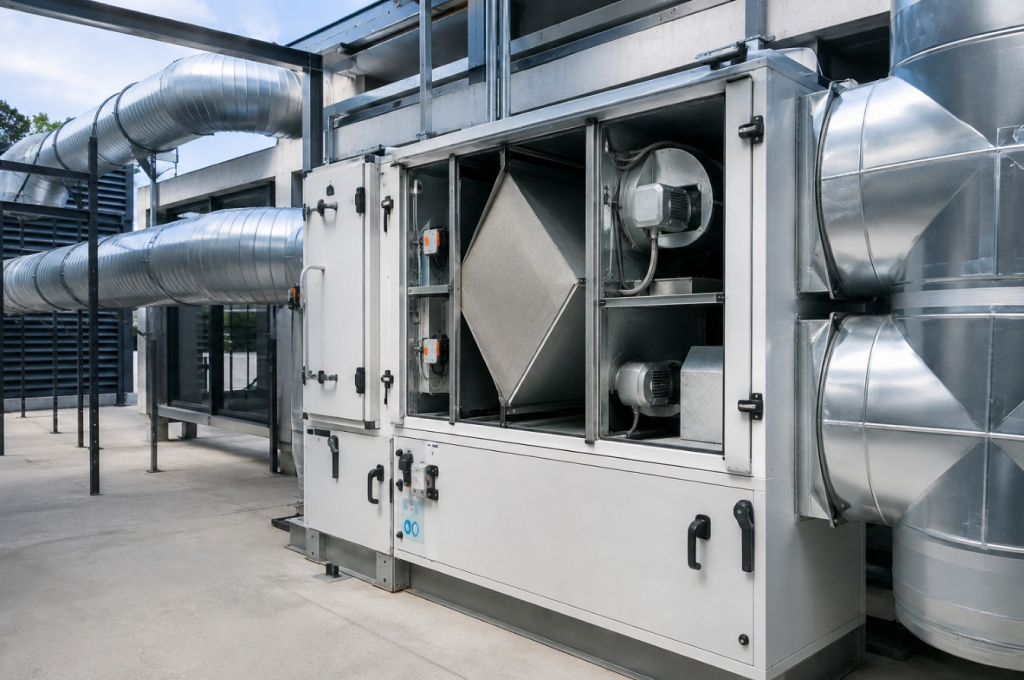
A heat recovery unit is an exchanger in which exhaust and fresh air pass each other and heat crosses from the warmer to the cooler stream without the two mixing. In winter the outgoing air preheats the incoming; in summer it precools it. The device produces no energy, it prevents energy already paid for from leaving. The best counterflow units return up to 90 percent of the temperature difference.
In practice this means fresh air enters the system in winter at nearly room temperature, so the heating coil adds only the last few degrees instead of the entire range. The required heating capacity, and often the building’s connected electrical load, shrinks accordingly. The same unit relieves the cooling plant in summer, so the savings do not end with the heating season.
Three exchanger families cover different requirements
A plate heat exchanger separates the streams with thin plates through which heat passes. It has no moving parts and the two streams never touch, which makes it reliable and hygienically predictable, the standard choice for offices, apartments, and mid-size comfort systems.
A rotary heat exchanger uses a wheel that turns through both streams, absorbing heat on one side and releasing it on the other; enthalpy versions transfer moisture as well. It achieves high recovery rates at large airflows and dominates in large air handling units, but a small share of exhaust crosses into the supply, so it is avoided where exhaust carries grease or odors.
A run-around system connects two separate coils with a piping loop filled with a water-glycol mixture. The air streams remain fully separated and can sit tens of meters apart, making it the solution for hospitals, laboratories, and commercial kitchens, and for retrofits where supply and exhaust never physically meet. Its recovery rate is lower, but it is often the only feasible option.
Waste heat from compressors and cooling plants can heat the building
Heat recovery does not end with ventilation. An air compressor converts over 90 percent of the electrical energy it draws from the grid into heat, which in most installations is simply blown into the surroundings. With a straightforward recovery system, that heat warms the production hall in winter and, through an exchanger, prepares domestic or process hot water all year round.
The same logic applies to cooling plants. The heat a chiller rejects through its condenser can preheat domestic hot water for a hotel or a pool, and process cooling that runs year-round can carry the heating of neighboring offices. Heat recovery VRF systems (variable refrigerant flow) do the same automatically: they move heat from rooms being cooled into rooms being heated, instead of rejecting it outside.
Buildings with high air turnover and simultaneous needs gain the most
The economics of heat recovery are strongest where airflow is large and constant. Commercial kitchens, industrial halls with process exhaust, swimming pools that change air continuously to manage humidity, and healthcare facilities with mandated air change rates spend more on conditioning air than on anything else, and that is exactly where a recovery unit pays back fastest.
The second group is buildings that heat and cool at the same time: a hotel with a conference hall and a pool, a shopping center where refrigerated cases run while entrance zones are heated, a plant where the process needs cooling while the workspace needs heating. Wherever one side of a building rejects heat the other is buying at that same moment, a heat recovery system turns two costs into one.
A serious analysis of a building therefore starts not with how many new kilowatts to add, but with an inventory of the energy already flowing through it: what is being exhausted, at what temperature, at what time of day. Only once that energy is put to work does it make sense to size new equipment, which then almost always comes out smaller and cheaper.
Heat recovery should therefore be seen as part of a building’s value, not as an accessory to its systems. It permanently lowers consumption and the required connected load, improves the energy rating, and keeps operating costs predictable for every future occupant or buyer. The energy a building already has is the cheapest energy available to it – it only needs to be kept.