In apartments, HVAC should solve everyday problems: pleasant temperature, quiet operation, healthier air, and reasonable energy use. Unlike large buildings, apartments usually do not have space for complex technical systems, so the solution needs to be simple, efficient, and adapted to real everyday living.
An apartment is not just a smaller version of a house or commercial space. It has a limited number of rooms, a specific layout, neighboring installations, façade limitations, and often limited space for outdoor units. That is why a good choice does not mean installing the most equipment, but finding the right balance between comfort, cost, and practicality.
The most important criteria in an apartment
In residential spaces, noise, uneven temperature, and indoor air quality are noticed the most. A unit that is technically powerful enough can still be a poor choice if it is too loud, poorly positioned, or does not cover the space properly.
In smaller apartments, one well-selected inverter unit is often enough, especially if the layout is open. In larger apartments or apartments with several separate rooms, a multi-split approach or a combination of several indoor units may deliver better results. The goal is to avoid a situation where one room is overcooled while another remains too warm.
Ventilation is often neglected, but it is becoming increasingly important in apartments. Better insulation and higher-quality windows reduce energy losses, but also reduce natural air exchange. Without controlled ventilation, humidity, condensation, odors, and a feeling of stuffiness can appear.
Solutions that usually work well
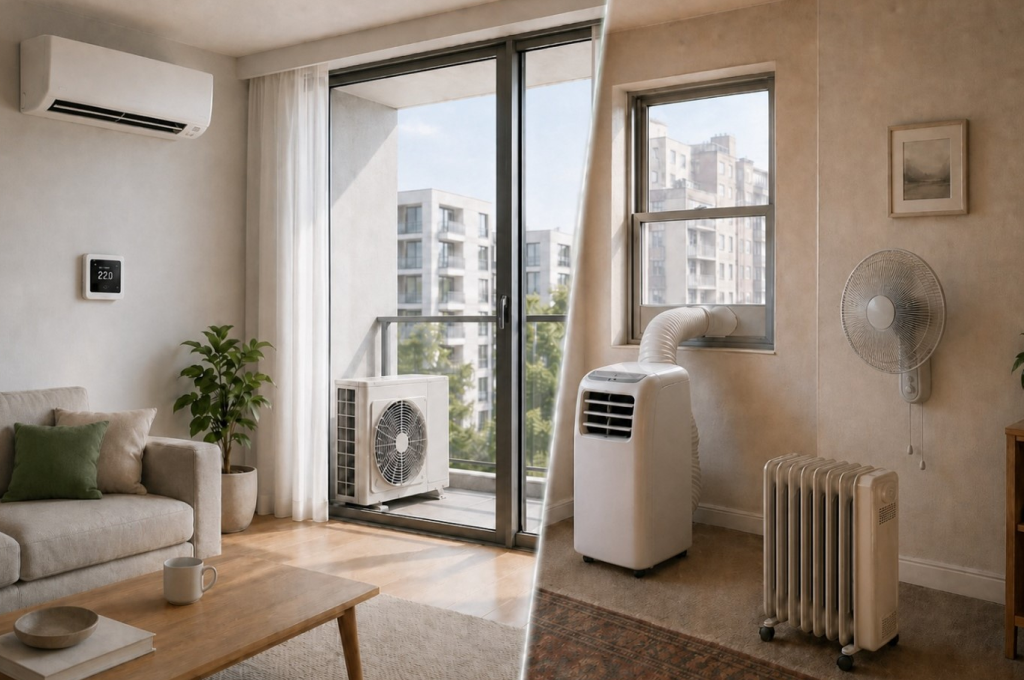
For most apartments, the most practical solutions are those that do not require complex infrastructure but still deliver a visible effect. Inverter air conditioners are often a good choice for heating and cooling, especially when properly sized and positioned. Smart thermostats or basic automation help maintain stable temperature without constant manual adjustment.
During renovation, underfloor heating can be considered, especially in combination with an efficient heat source. It provides even comfort, but it is not always practical in apartments where major adaptation work is not being done.
Controlled ventilation or local heat recovery units may make sense in apartments with humidity problems, weak natural ventilation, or good airtightness. A complex solution is not always necessary, but air quality should not depend only on occasional window opening.
Solutions that often create more problems than benefits
Portable air conditioners, electric heaters, and temporary solutions can help in the short term, but rarely provide a good long-term result. Portable air conditioners are often noisy, take up space, have lower efficiency, and require improvised exhaust of warm air. Electric heaters can quickly warm a small zone, but they use a lot of energy and do not solve comfort throughout the apartment.
Old radiator systems can be acceptable if they are part of stable central heating, but they are not always flexible enough. Problems occur when the user has no room-by-room control or when the system no longer matches new habits, better insulation, or a different usage pattern.
In apartments, overcomplication is especially unhelpful. Too many devices, poorly positioned indoor units, and overly complex solutions often create more noise, more service points, and weaker visual integration into the space.
Practical logic of selection
A good HVAC solution for an apartment should be quiet, easy to use, energy-rational, and flexible enough for different seasons. Before selecting equipment, it is important to review the room layout, apartment orientation, insulation quality, household habits, and existing installations.
Proper thermostat use alone can reduce annual heating and cooling costs by up to 10%. In apartments, this is not only a matter of savings, but also comfort: stable temperature without sudden changes makes the space more pleasant to live in.
The best solution is the one that fits the apartment, not the one that looks strongest on paper. When equipment is properly selected, well positioned, and easy to control, HVAC becomes part of everyday life that is barely noticed — except through better air, quieter operation, and lower bills.