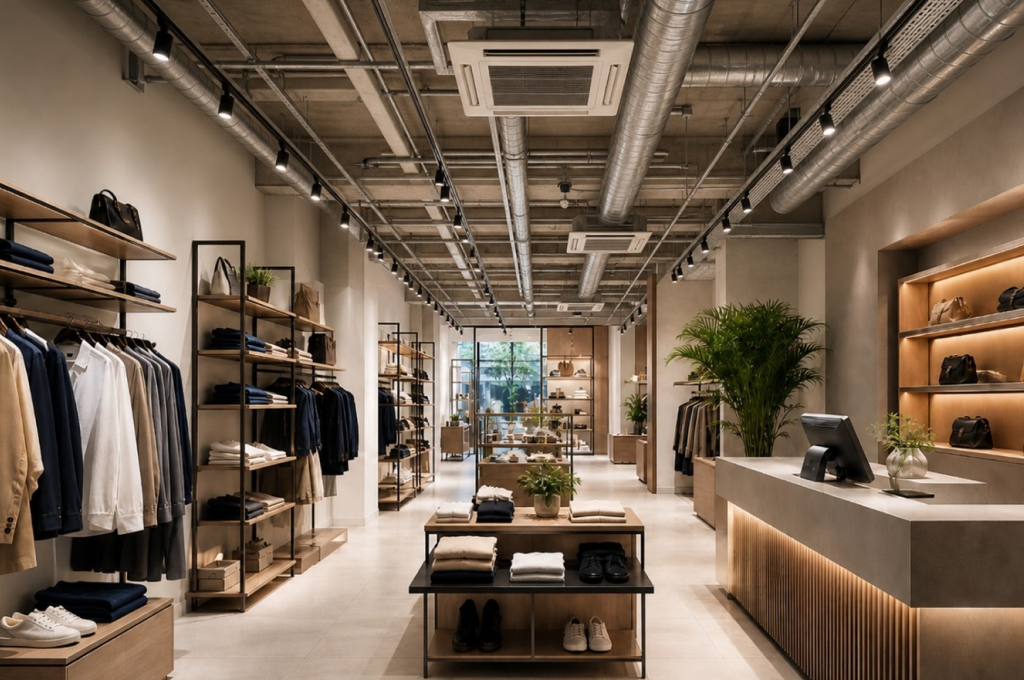
In retail, HVAC has a different role than in an office or hotel. Here, indoor conditions directly affect customer behavior. If the space is too warm, stuffy, cold near the entrance, or poorly ventilated, the customer stays for a shorter time and leaves faster. If the temperature is stable, the air pleasant, and the space comfortable to move through, the shopping experience feels more natural.
Retail does not sell only products, but also the feeling of being in the space. HVAC is part of that experience, even though the customer usually does not notice it while it works well.
Entrances, shop windows, and customer traffic change conditions
Retail spaces have specific loads. Doors open frequently, shop windows and glass surfaces allow solar heat gain, lighting adds heat, and the number of customers changes throughout the day. In fashion stores, comfort in fitting rooms matters. In supermarkets, refrigerated display cases add another layer of complexity. In smaller shops, uneven temperature between the entrance and the back of the store can become a problem.
That is why retail HVAC should not be planned only by square footage. Customer flow, dwell zones, entrance area, checkouts, fitting rooms, shelves, shop windows, and employee work positions all need to be considered.
Customer comfort and employee comfort are not the same issue
Customers spend less time in the space, move through it, and react to their first impression. Employees spend an entire shift in the same space. A poor HVAC solution can be uncomfortable for customers and exhausting for staff at the same time.
For example, strong cold air near the entrance may seem acceptable to a customer who passes through quickly, but it can be uncomfortable for employees at the checkout throughout the day. On the other hand, a weak system may maintain acceptable conditions during a quiet period, but fail when traffic increases.
A good retail HVAC system needs to support both experiences: a pleasant customer visit and stable conditions for the people working in the space.
Energy efficiency depends on the rhythm of sales
Retail stores often have long working hours, weekend operations, and seasonal changes. HVAC therefore needs to follow the rhythm of the business. The space does not need to operate at the same intensity before opening, during peak traffic, and after closing.
Smart control and proper scheduling can reduce consumption without reducing comfort. Proper temperature settings alone can reduce annual heating and cooling costs by up to 10%, while in buildings with several zones, additional value comes from separate control of the entrance, main sales area, storage, and staff areas.
In larger retail spaces, centralized control, regular consumption monitoring, and a service plan often make sense. In smaller shops, the priorities are proper sizing, good positioning of indoor units, and avoiding direct airflow toward customers or employees.
A special challenge: odors, humidity, and refrigeration equipment
Retail is not a single category. A pharmacy, boutique, supermarket, furniture showroom, and cosmetics store do not have the same HVAC needs. In food retail, odors, refrigerated displays, and temperature stability matter. In pharmacies and cosmetics stores, control of heat-sensitive products may be important. In boutiques, fitting-room comfort and customer dwell time matter. In larger showrooms, the challenge may be the large volume of space.
That is why retail HVAC is best planned according to product type and customer behavior. A system that works well in a boutique may not be suitable for a grocery store, and a supermarket solution is not necessarily applicable to a pharmacy or showroom.
HVAC as part of the sales experience
In retail, good HVAC is measured through stable indoor conditions, lower bills, and fewer employee complaints, but also through its indirect influence on customers. Pleasant temperature and good air quality do not guarantee a sale, but they remove obstacles that can shorten the customer’s stay.
The best solution follows the real flow of the space: entrance, shop window, main sales zone, fitting rooms, checkout, storage, and staff positions. When these zones are well aligned, HVAC stops being just a technical installation and becomes part of an atmosphere that supports sales, comfort, and everyday operation.