How a hall with a solar roof becomes a ticket to the market, not just a lower bill (an exporter’s example)
For years, solar was sold as savings. Now there is a new, much harder reason. Large buyers in Europe report on their own sustainability and push that requirement down the supply chain, all the way to their suppliers. Increasingly, before they sign or renew a contract, they ask a question nobody was asking five years ago: what is your carbon footprint, and how much of your energy comes from renewable sources?
For an exporter, that is no longer a nice-to-have. It is a condition of staying in the game. And a very similar question increasingly comes from the bank too, before a green loan or fund financing is approved.
A new reason for solar: no longer just savings
While solar was only a way to cut the bill, the decision could be postponed. Now the nature of the question has changed. A buyer who has to report the emissions of its own supply chain sees your factory as part of its footprint. A supplier without a credible answer risks losing the business to a competitor who has one.
So solar moves from the “cost reduction” category into the “market and money access” category. The same investment defends revenue and opens financing, not only trims the bill.
Scenario: an exporter who can’t afford to lose the buyer
Picture a furniture manufacturer that sells most of its output to the EU market. Business is good, the hall is running at full capacity, and then one day a questionnaire arrives from a key buyer: emissions data, share of renewable energy, a decarbonization plan for the coming years.
If the factory is powered solely from the grid, the answer looks weak on paper. If, however, part of the energy comes from its own solar roof, measurably and verifiably, the answer suddenly works in the supplier’s favor. The difference between those two scenarios isn’t only environmental; it decides who keeps the contract.
Why the hall carries this story
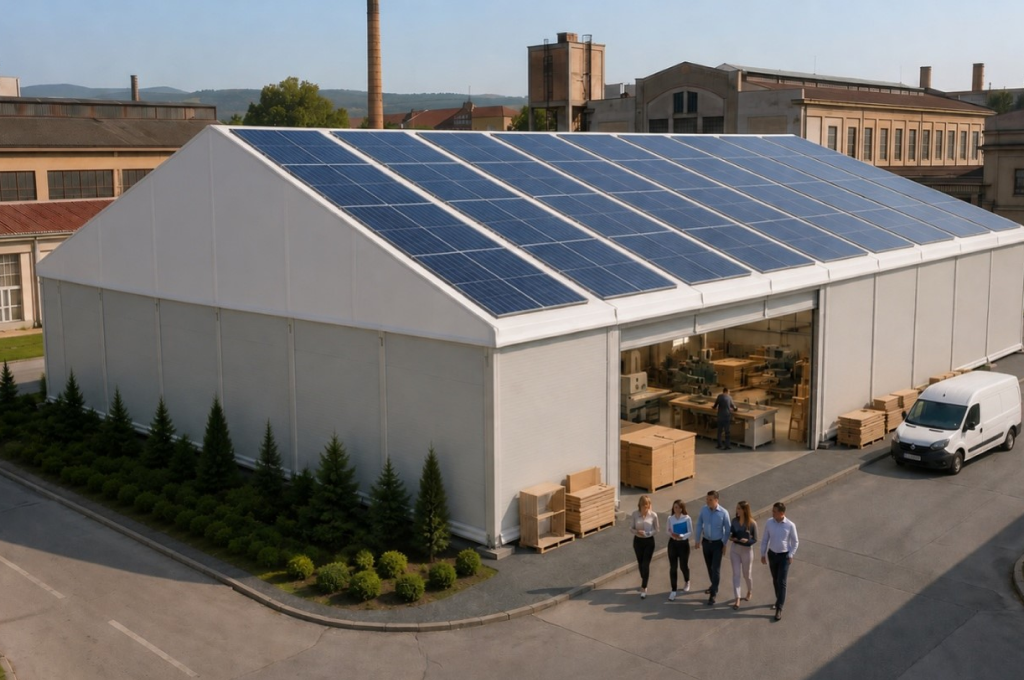
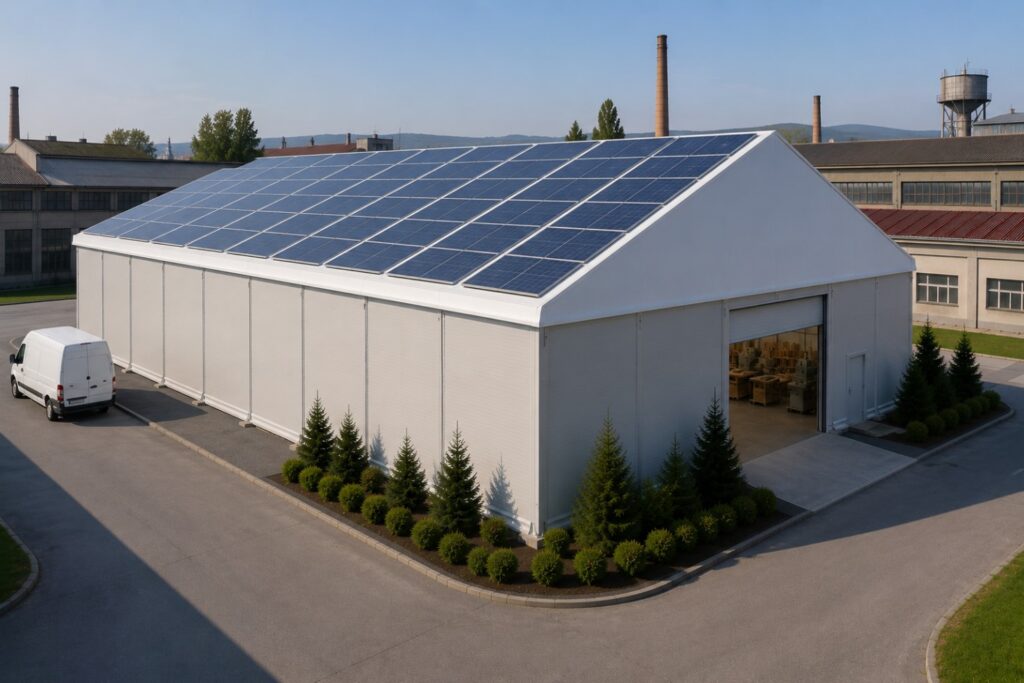
The factory is where the footprint is created and measured, so it is logical that the solution starts there too. With a modular hall, the roof can be engineered for solar during construction, so green energy is built into the building rather than bolted on years later. A canopy with chargers for electric vehicles adds a visible proof of decarbonization: cleaner logistics and a greener fleet.
In other words, the hall stops being only a production space and becomes your ESG proof: something you can show a buyer, an auditor and a bank.
From footprint to proof: what actually gets measured
On-site solar directly reduces the emissions tied to bought electricity, the part of the footprint that is easiest to recognize and hardest to hide. And, crucially, the effect is measurable: how many kilowatt-hours were produced, what share of consumption it covers, how much emissions were avoided. That is exactly what reports, audits and buyer questionnaires ask for.
A concrete, verifiable number always beats a vague promise to “do something about sustainability”.
Market and money, not only conscience
The benefit is threefold and very tangible. First, you keep and win customers who are decarbonizing their chain. Second, you reach more favorable green financing and fund support more easily, because your indicators are clear. Third, the old saving on the bill still applies, now as a bonus, not as the only reason.
Few investments defend revenue and cut cost at the same time. Solar on an exporter’s hall is exactly that kind.
The right time is before they ask
The pressure is moving down the supply chain and will not skip smaller suppliers. The advantage goes to the one who already has the answer when the question arrives, not the one who only then starts looking for it. If energy is built into the hall in time, a future demand turns into a present advantage, and an asset that holds value across the building’s entire working life, measured in decades.
| If you export or supply large customers, the carbon-footprint question is only a matter of time, and the answer is built before it arrives. A hall with a solar roof reduces the footprint in a measurable, verifiable way and becomes an argument with both the customer and the bank, not just a lower bill. Schedule your free feasibility study: nevena.milenkovic@energize.rs |