A hall that grows with your business
The story of a growing business regularly gets stuck on space. A garage, a basement, a rented corner, a weekend workshop — at some point the space stops being the stage for the work and becomes its biggest constraint. An order comes in that can’t be filled because there’s nowhere to produce it. A machine has been ordered, but there’s no room to install it. A new worker is needed, but there’s nowhere to put them.
The traditional answer — take out a large loan and build a proper hall — often means a leap the business isn’t ready to make. The size is decided up front, capital is committed before the market signal arrives, and a hall designed for a five-year plan rarely actually follows that plan in practice.
The in-between phase — the hardest moment for space
A typical case looks like this. The business started in a small space, the first results are in, customers are coming back, and serious orders are arriving. Everything says you should expand — but the next step looks like jumping across a big gap. The classic approach requires you to decide size, layout and capacity all at once. If the plan is optimistic, the hall sits half-empty. If it’s overly cautious, it’ll be tight within a year.
A hall built in stages
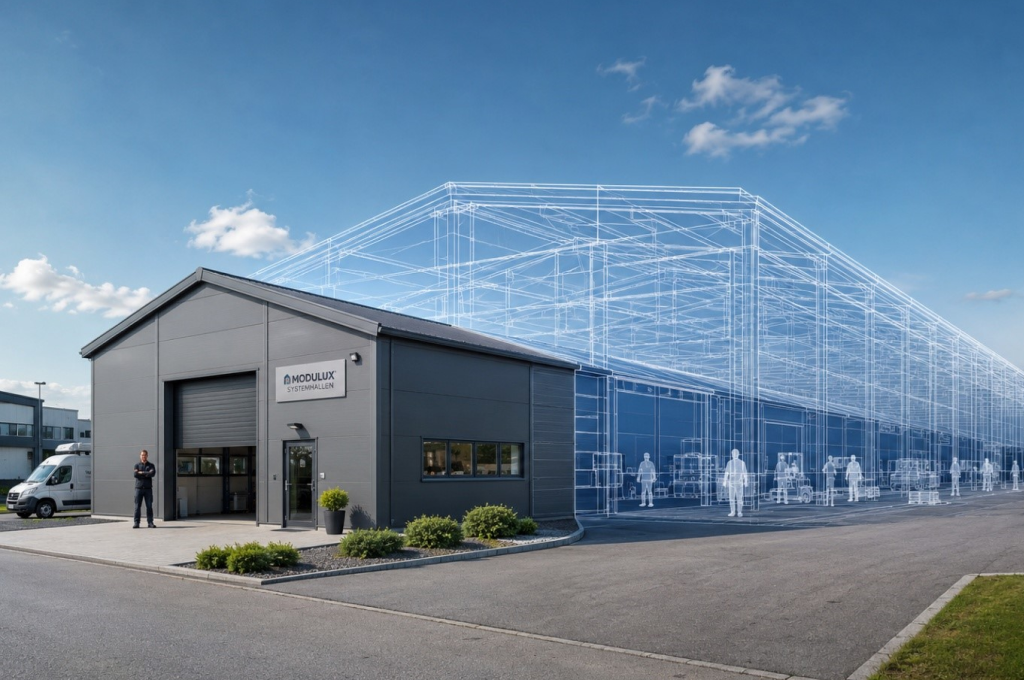
A modular hall doesn’t ask for that kind of decision. The initial module can be compact — the smallest hall is 10 to 15 meters wide and 5 meters long, about fifty to seventy-five square meters. That’s enough for a real first workshop with industrial power, ventilation and basic equipment. When that module fills up, the next one is added — laterally, in a row, or in an L-shape. The structure is designed from the start for expansion, which means no new permits, no new structural calculations and no new foundations.
Solar follows the same logic — panel capacity is sized to the modules currently installed, and grows alongside new sections of the hall later. No new grid connection, no new transformer station.
A hall that follows the rhythm of the business
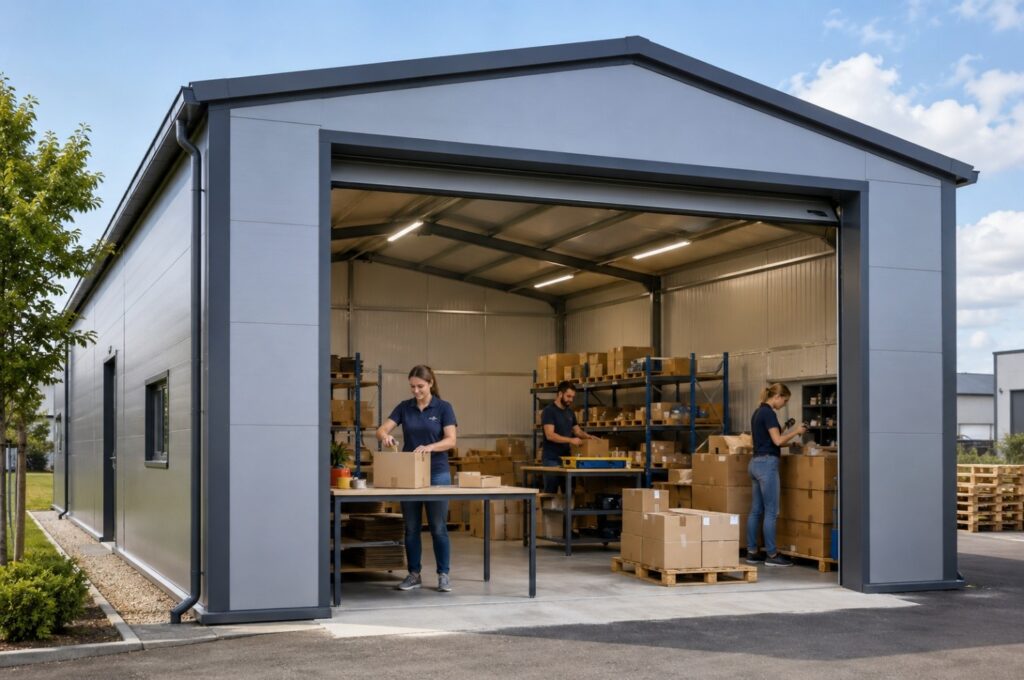
Seen over time, it looks something like this. Year one — around fifty square meters, one worker, the first machines, the first few serious customers. A real workspace in appearance, compact in size — exactly as much as you need and as much as you’re prepared to finance today.
Year two — production has doubled, you add a second module, your first full-time employee comes on. Year three — a forklift enters, you add space for finished-goods storage, the roof fills up with panels. Year five — a real small facility, several modules in a row, automated lines, your own dispatch room.
All that time the building grew together with you, not ahead of you. You weren’t paying for square meters you didn’t use, nor working in a space smaller than you needed. Every new module was an investment that matched where the business was at that moment.
Which businesses benefit most from this
The biggest difference is felt by a business stepping out of improvised space into its first real workshop — small-scale food production, cosmetics, soap and candle makers, bakers, design and craft workshops, small metal and wood manufacturers, repair services. Then there are agribusinesses outgrowing the family farm, and online-based companies that started in a garage and now need real production space.
The same applies to companies outgrowing rented space. Rent rises every year, the landlord won’t invest in the building, and the business loses money on something that will never be its own. A modular hall often costs less in the first phase than three years of rent for equivalent space — and the investment doesn’t disappear when the lease ends.
A difference that isn’t measured in square meters alone
The biggest advantage of this approach isn’t only flexibility in size, but the difference between a business always chasing space — the next bigger one, the next better one, the next one where everything starts from scratch — and a business where the space moves with it. For those thinking about the next step today — from garage to facility, from rent to ownership, from improvisation to system — it’s the difference between one big risk and a series of small, controlled decisions.
| If your business is outgrowing its current space — or just taking that first step from improvisation into a stable building — a modular hall is worth a serious look before you sign a new lease or commit to traditional construction. A modular hall starts from a compact module of about fifty square meters and grows with your business — without a new project, new permits or new capital every time you’re ready for the next step. Schedule your free feasibility study: nevena.milenkovic@energize.rs |