Lessons from a 56-Unit Solar Modular Camp
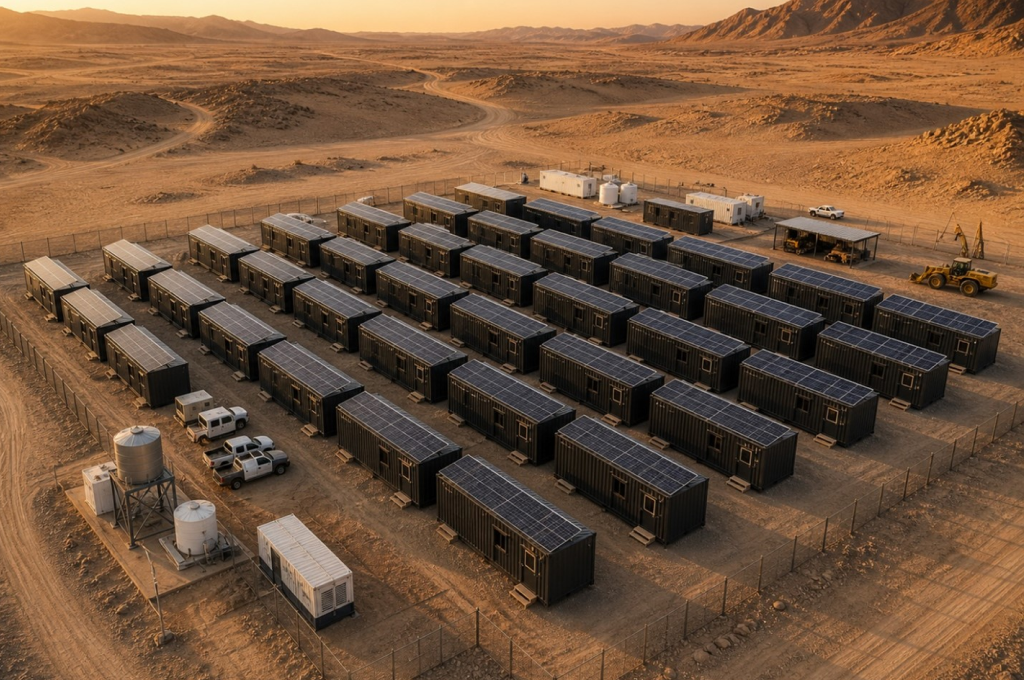
The real test for any idea is not the presentation — it is performance in the field. A camp of 56 solar-powered modular units in a remote part of Oman proved that this model works precisely where it is hardest: without stable infrastructure, in extreme heat, with tight deployment timelines. For any company planning accommodation for seasonal or project-based workers, this is a case worth studying — not to copy it outright, but because of the principles behind it.
Three Problems Every Temporary Camp Has to Solve
Temporary worker accommodation consistently runs into the same three barriers, regardless of location or sector:
Energy — in remote locations, power is expensive, unreliable, or logistically complicated
Time — projects cannot wait for lengthy construction; a camp must be operational within days
Comfort — poor conditions directly affect productivity, worker retention, and employer reputation
Oman was an ideal test because it exposed all three problems at once. Desert climate, distance from infrastructure, high operational pressure. A system that performs there has something meaningful to say to every project across Europe and beyond.
What Was Built — and Why It Works
The 56-unit flat-pack modular camp included office space, accommodation modules, and portable sanitary units. The key value was not solar alone — it was that the entire concept was engineered around operational reliability.
The office zone, equipped with solar panels and battery storage, operates independently from the grid — day and night. Core site operations do not depend on whether the grid is available or whether the generator starts.
Add to that: serious insulation, a roof structure designed for high temperatures, efficient air conditioning, and separate sanitary modules. Solar matters, but it is not sufficient on its own. Real results only come when the energy system, thermal comfort, and camp usage logic are designed together as a whole.
For an investor, that translates directly into a lot of things, for starts – lower fuel and servicing costs from day one, faster installation because units arrive ready, with no extended on-site construction. Also, operational risk is low for a good reason – the system does not depend on a single point of failure. Conditions for workers are automatically getting better because of stable temperatures, quiet nights, and functional shared spaces.
An Investment That Does Not Burn Up in One Season
One of the most important lessons from this project is not technical — it is economic. Modular units are not tied to a single location. When a project ends, the modules move, reconfigure, or expand at the next site.
Instead of a cost that gets written off in one season, this is an asset that can be reused — across projects, seasons, and locations.
For companies in agriculture, construction, mining, and food processing — where the workforce moves and requirements shift — this fundamentally changes the investment logic. You are not buying a camp. You are buying infrastructure that travels with your business.
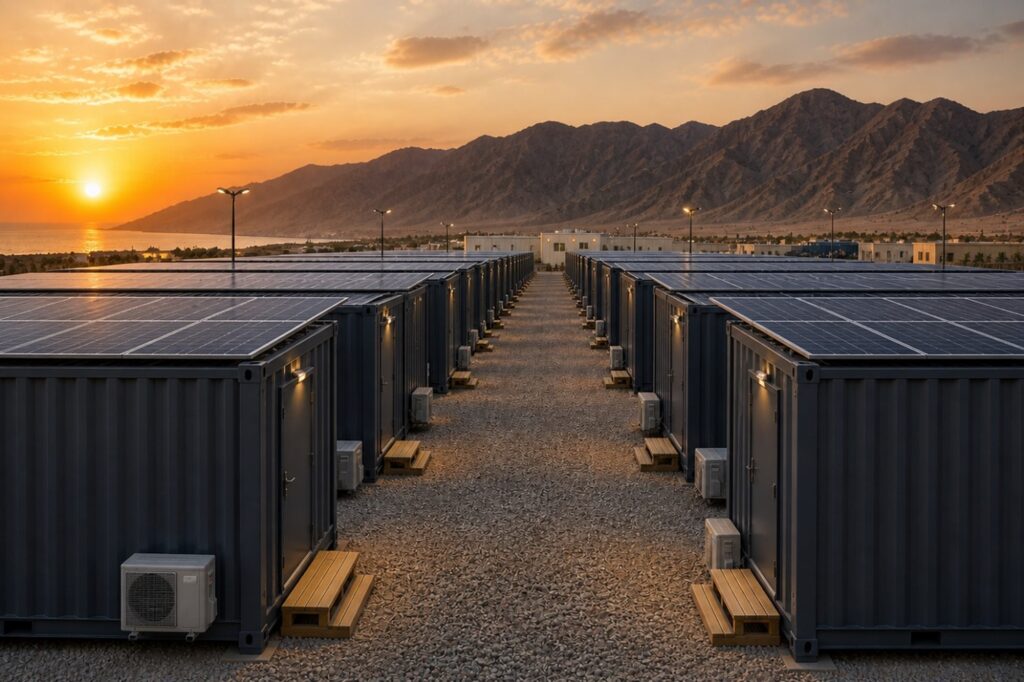
Solar modular container — the same principle, adapted for different uses and locations
What Europe Can Specifically Take from This
The system logic from Oman transfers directly — with the necessary adaptations. The climate is different, but the core challenges are shared: remote sites, expensive logistics, tight deadlines, and growing pressure on working conditions.
In practical terms, applying this logic means:
Phased camp expansion aligned with project pace — no excessive upfront commitment
Solar and battery storage where energy costs or grid instability justify the investment
A robust thermal envelope — equally critical for heating as for cooling in temperate climates
Planned sanitary blocks and shared spaces — designed in from the start, not added as afterthoughts
A reuse-first mindset — modules that are ready to follow the next project
The goal is not to copy a desert camp. The goal is to adopt the design discipline: a system engineered to work, not a collection of parts patched together as problems arise.
A Decision That Starts with One Question
The Oman example does not argue that every modular camp is automatically good. It shows that quality comes from carefully connected elements — insulation, climate control, solar, batteries, and fast-deployment logic — engineered together from the beginning.
For companies planning accommodation for seasonal or project workers today, the real message is this: do not just think about how to set up a camp — think about how to get it operational fast, run it efficiently, and use the same investment more than once. Framed that way, solar-powered smart containers stop being a niche product and become a measurable answer to a very real operational problem.