Connecting a facility to the medium-voltage grid is a procedure with clearly defined steps, but there are also enough points where a project can lose several months if those steps are carried out in the wrong order.
This guide explains how the process works in practice, from the initial concept to energising the transformer substation.
The process begins with an application to the distribution system operator, defining the location, requested capacity and intended use of the facility.
The operator then issues the grid connection conditions, specifying the connection point, connection method, technical equipment requirements and the investor’s obligations. For higher capacities and connections involving electricity generation, additional grid impact studies may also be required.
These conditions form the basis for everything that follows. The application should therefore be submitted early and with a realistic capacity estimate, because changing the requested capacity at a later stage may mean returning to the beginning of the process.
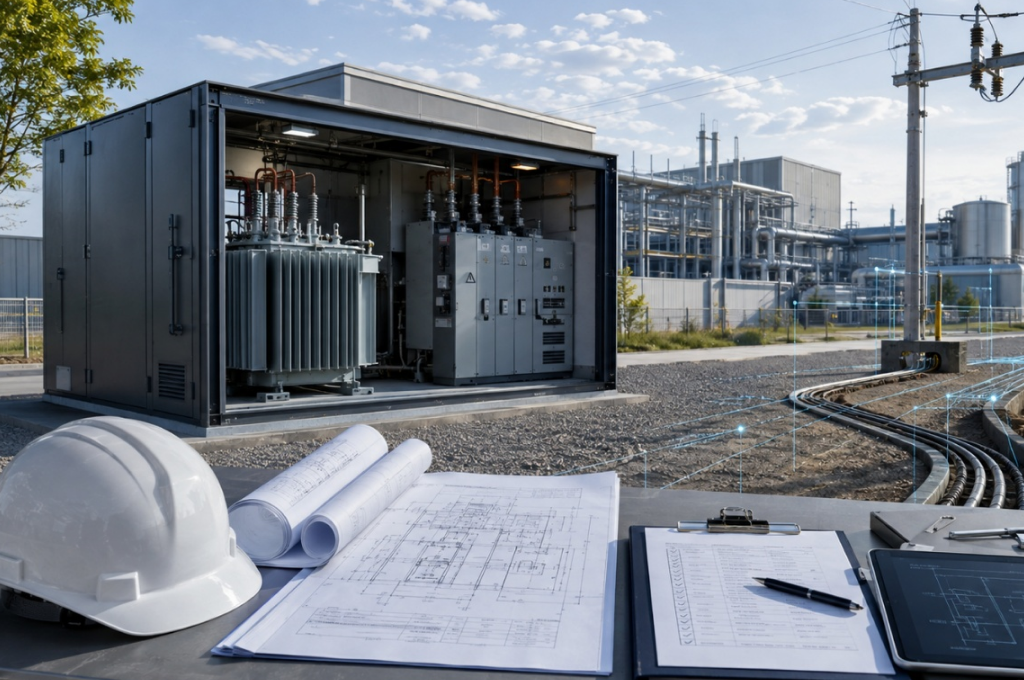
Based on the connection conditions, the design documentation for the transformer substation and the connection line is prepared and submitted through the required approval procedure.
Two common mistakes are made at this stage.
The first is sizing the system only according to current electricity consumption, without allowing sufficient reserve for future growth, solar generation or EV chargers, even though the additional cost of selecting equipment one capacity step higher is often relatively small.
The second is designing equipment that formally meets the minimum requirements but does not reflect the facility’s actual needs in terms of reliability, monitoring and future expansion.
The next step is signing an agreement with the distribution system operator, which defines the connection fee, scope of works and project deadlines.
Part of the works is carried out by the operator, while the remainder is performed by the investor through contractors holding the appropriate licences.
At the same time, construction of the transformer substation proceeds, including civil works, equipment installation, cable connections and grounding.
Effective coordination between these two workstreams is where several weeks can be saved. A completed substation waiting for the connection line, or a completed line waiting for the substation, means that someone is paying financing costs for equipment that is not yet operational.
Before energisation, all required testing must be completed. This includes grounding resistance measurements, cable insulation testing, protection system functionality checks and verification of metering equipment.
The operator inspects the completed installation and, once everything complies with the connection conditions and approved design, the substation is energised and the agreements for system access and electricity supply are signed.
The administrative work at this stage may appear to be a formality, but this is where many delays occur when project documentation has not been maintained properly throughout construction.
The overall duration depends on the complexity of the connection, equipment delivery times and the operator’s schedule. However, for a serious industrial connection, the realistic timeframe should be measured in months rather than weeks.
The single most important factor in accelerating the process is complete and accurate documentation at every stage.
The most common cause of delay is the optimistic assumption that one of the steps will be completed faster than the formal procedure allows.
An experienced partner that has completed this process many times does not primarily create savings through a lower equipment price, but by reducing delays. In grid connection projects, time is usually the most expensive item.