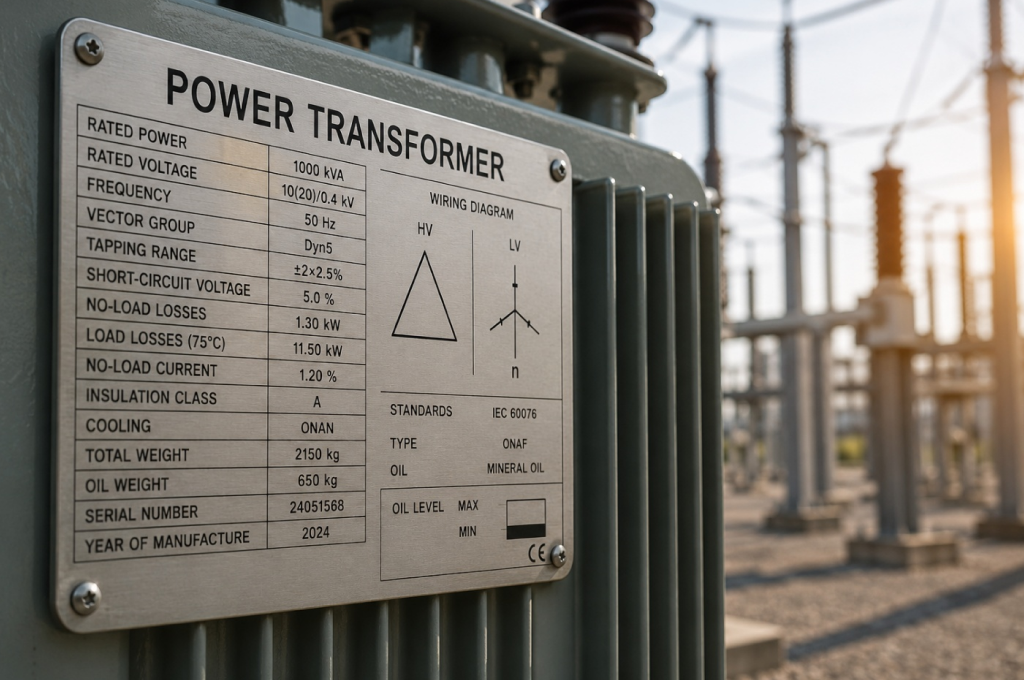
Every transformer carries a metal plate covered in numbers and markings that look like a code meant for the initiated. Yet it actually states everything worth knowing about the machine: how much it can deliver, how it is connected, and how it is cooled. Here is a translation of the most important fields into plain language.
The first thing the eye looks for is the rated power, expressed in kilovolt-amperes, kVA. This is apparent power, the machine’s total capacity, while the useful power in kilowatts depends on the power factor of the load. The practical consequence: a facility with a poor power factor draws fewer useful kilowatts from the same transformer, which is why reactive power compensation frees up substation capacity without replacing a single piece of equipment.
The next field is the rated voltages, for example 10(20)/0.4 kV. The number in brackets indicates a dual ratio: the machine can operate at both 10 and 20 kV, which is standard today given the grid’s gradual transition to the higher voltage. Alongside this there is usually a tapping range, typically several tap-changer positions in steps of plus and minus two and a half percent, used to adjust the output voltage to conditions in the grid on distribution transformers, with the unit de-energized.
A designation such as Dyn5 describes the winding connection. The capital D says the higher-voltage winding is connected in delta, the lowercase y that the lower-voltage side is in star, n that the neutral point is brought out — the one that makes single-phase loads possible, and the number 5 is the clock number, the phase displacement between the two sides expressed as a position of the clock hand. Why this matters: transformers operating in parallel must have the same vector group and clock number, the same ratio and a similar short-circuit voltage, otherwise circulating currents flow between them.
The short-circuit voltage, uk, expressed as a percentage, typically around four to six, tells you how much the machine limits short-circuit currents and how it behaves under load, and it is a key figure for protection design and for parallel operation.
Cooling designations such as ONAN stand for natural circulation of oil and air, ONAF the same with fans added, while dry-type transformers carry air-cooling designations.
The plate also lists the insulation class, weight, year of manufacture and serial number details that become worth their weight in gold the day a replacement is urgently needed. Which is why a photo of the nameplate of every machine in the company is the cheapest insurance policy there is: it costs nothing and fits in a phone.