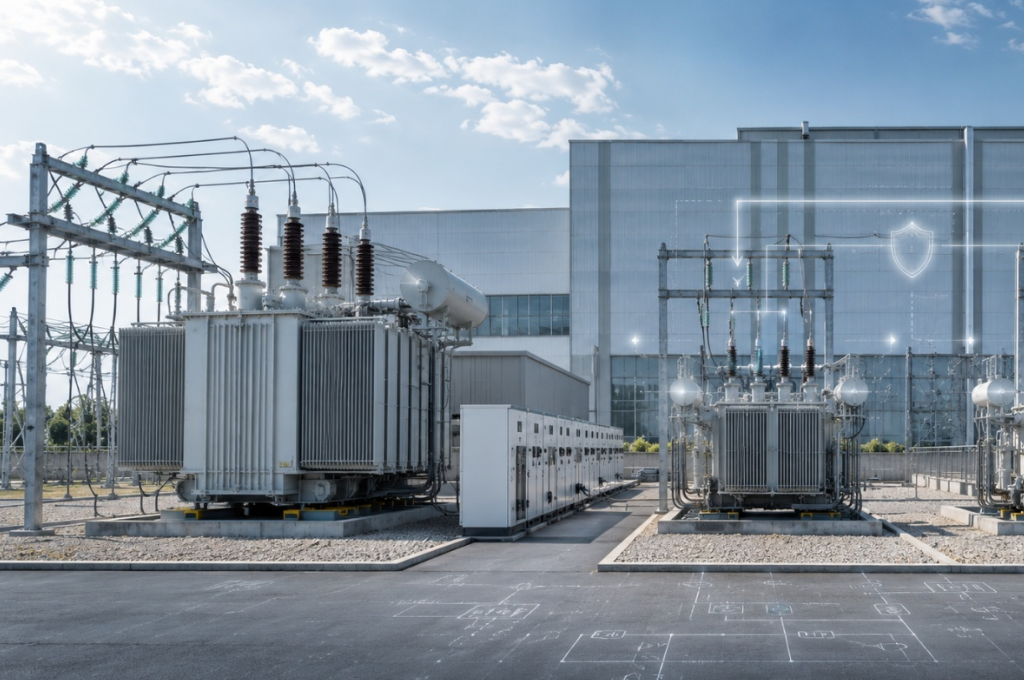
When designing a transformer substation for a larger industrial facility, a question eventually arises that may seem like a minor detail but actually determines the facility’s reliability for the next thirty years: should the system use one transformer with the full required capacity, or two smaller transformers that provide the same combined capacity?
One transformer means one single point of failure.
When it fails, everything stops, and the entire facility remains offline until the transformer is repaired or replaced. For larger units, this process can take weeks.
Two transformers designed so that each can carry the critical portion of the load mean that the failure of one unit does not bring production to a complete stop. Instead, the facility continues operating with priority loads only.
For production facilities where one hour of downtime costs more than the difference in investment, the choice is clear.
Two transformers also provide greater operational flexibility.
During periods of low consumption, such as at night, over weekends or during scheduled shutdowns, one transformer can be switched off, eliminating its no-load losses.
Maintenance can be carried out without disconnecting the entire facility.
Electricity demand that grows in stages can also be matched by phased investment. The second transformer can be installed when required, provided that the substation and distribution system were prepared for it from the beginning.
Two smaller transformers cost more than one large transformer with the same total capacity. They also require more space, additional medium-voltage switchgear cells and a more complex low-voltage distribution system with a bus coupler.
Parallel operation of two transformers also requires technical discipline. Their vector groups, transformation ratios and short-circuit voltages must be compatible; otherwise, the load will not be shared evenly.
None of these requirements represents an obstacle, but they are reasons why the system concept should be defined during the design stage rather than improvised later.
The question that must be answered honestly is this: what happens in the facility when the transformer stops operating, and how much does that cost per day?
When the consequences are manageable, one transformer supported by a reliable service agreement may be the rational choice.
When the consequences would be catastrophic, redundancy is not a luxury. It is part of the facility’s basic design, just like a fire-protection system.
There are also intermediate solutions between these two options, such as installing one transformer while preparing space and infrastructure for a second, or defining a clear plan for temporary power supply.
The important thing is that the decision is made deliberately, because changing the system after commissioning is difficult and expensive.