The location of a substation is often decided last, after the layout of the buildings has already been drawn, leaving the station to occupy whatever corner remains. However, choosing the wrong micro-location is a mistake that is difficult to correct and can affect the project throughout permitting, construction, and the entire operational life of the facility. These are the key criteria that should be reviewed before the substation is added to the site plan.
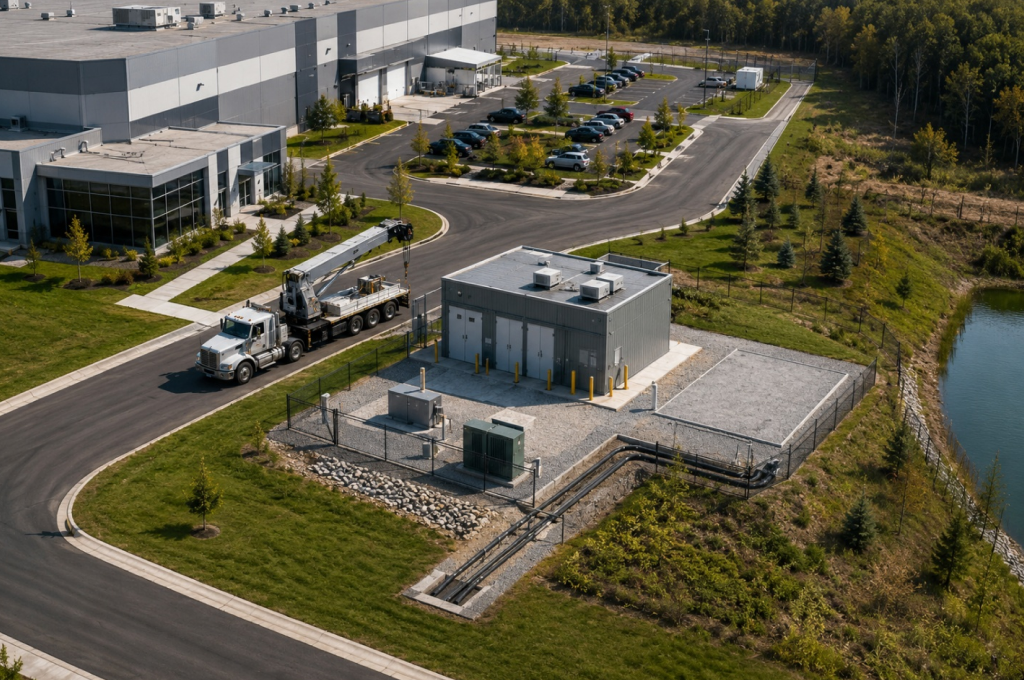
The first and most frequently overlooked requirement is permanent access for a heavy vehicle equipped with a crane. This access is needed not only during installation, but throughout the lifetime of the substation, as the transformer may eventually need to be replaced. An access route that is later converted into a lawn or parking area means that any future intervention will require specialised machinery and additional expense. Adequate manoeuvring space must also be provided in front of the station so that the doors can be opened and the equipment removed safely.
Regulations and engineering practice define the required distances between the substation and buildings, property boundaries, and areas occupied by people. Oil-filled transformers are subject to additional requirements because of their fire load, including oil containment systems and fire protection measures in relation to neighbouring facilities.
A transformer also produces a low, continuous humming sound that can travel farther at night than expected. For this reason, the station should not be placed directly next to offices, occupied rooms, or a neighbour’s bedroom. Noise complaints are often more difficult to resolve than technical problems.
The station should not be installed in a low-lying area where water collects or in a flood-prone zone, while the cable compartment beneath it must remain dry. The soil-bearing capacity and groundwater level should be checked before the foundations are constructed.
In industrial environments, the surrounding atmosphere must also be considered. Dust, corrosive vapours, and the proximity of combustible materials influence the choice of enclosure, protection rating, and ventilation system, because the substation continuously draws in the air around it.
The economic criterion is straightforward: the closer the station is to the grid connection point and the centre of electrical demand, the shorter and less expensive the cables will be, with lower associated power losses.
One criterion that is frequently forgotten is future expansion. Space should be reserved next to the substation for an additional transformer, a battery storage container, EV charging equipment, or other infrastructure, because a facility’s power requirements usually increase over the operational life of the station.
A well-chosen micro-location is never noticed. A poor one is paid for every time something needs to be done.