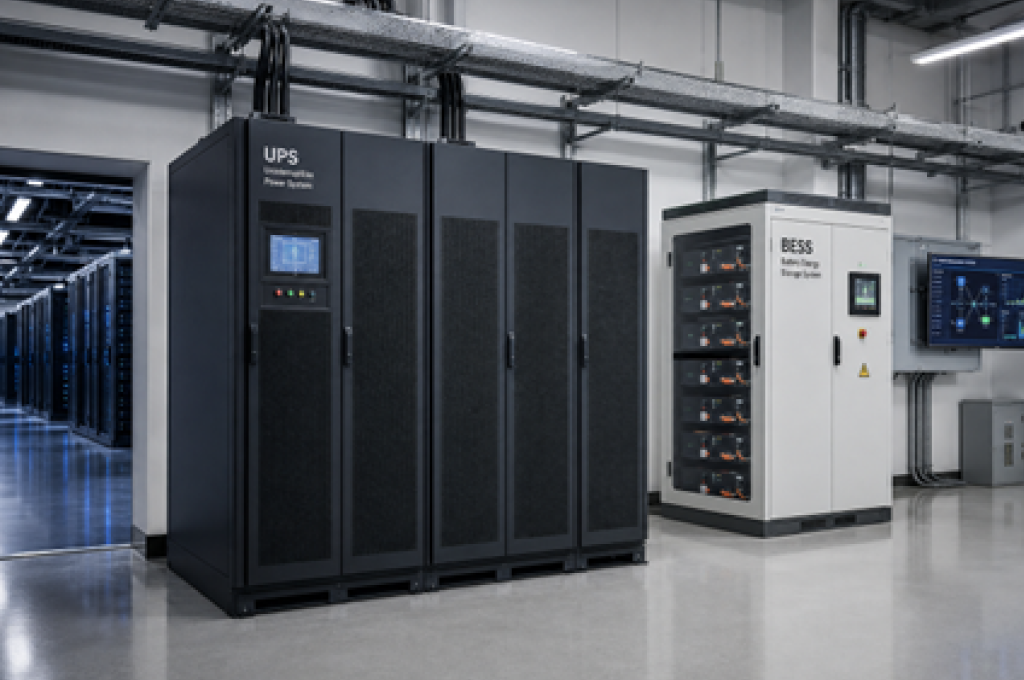
When a company starts evaluating investments in energy infrastructure, UPS, batteries, energy storage and solar are often grouped into the same conversation. At first glance that seems reasonable: in every case we are talking about electricity, continuity of operations and battery-based systems. In practice, however, UPS and BESS do not solve the same problem. That is precisely why investors who want both resilience and sound economics increasingly look at them together rather than as alternatives.
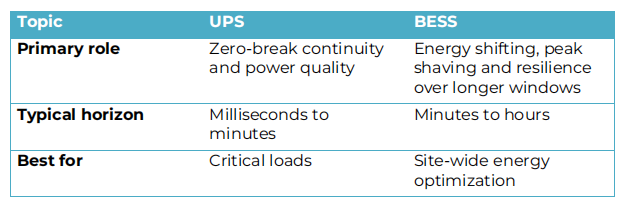
A UPS is designed to keep critical loads running without interruption the moment the grid fails or the quality of supply becomes unacceptable. Its value lies in response speed, output stability and the protection of processes that must not stop even for a fraction of a second. BESS, on the other hand, is not primarily a tool for milliseconds. It is a tool for minutes and hours. Its main value is energy management: peak shaving, time-of-use optimization, integration with solar, reserve energy for longer outages and better control of total energy cost.
That is why the serious customer usually does not need to ask whether to choose UPS or BESS. The real question is how to combine them correctly so that the site gets both uninterrupted operation and energy flexibility.
Why UPS and BESS are not the same thing
In the simplest terms, UPS protects the process, while BESS optimizes energy. That is the core distinction. A UPS must take over the load immediately, without the interruption that would crash a server, stop a production line, destroy a laboratory sample or disrupt medical equipment. For UPS design, the critical factors are inverter quality, transfer behavior, power electronics reliability, redundancy and system behavior in extreme operating modes.
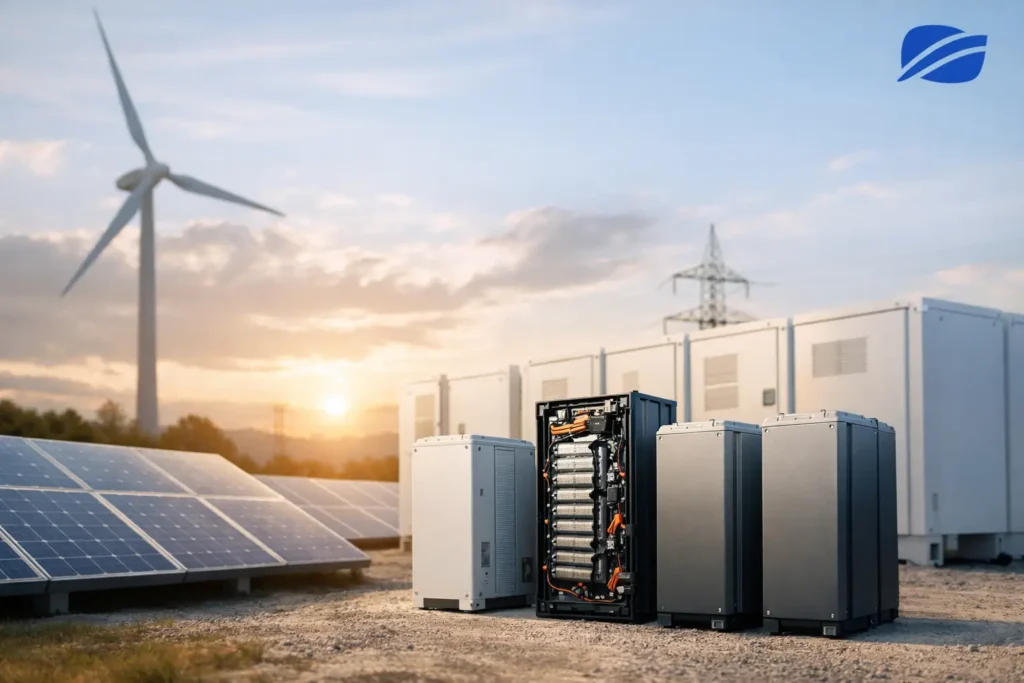
The logic of BESS is different. Here the focus is on energy capacity, charging and discharging strategy, power-to-energy ratio, EMS integration, tariff optimization, interaction with photovoltaics and the ability to shift or soften demand whenever that is financially or operationally beneficial. In other words, UPS preserves continuity, while BESS delivers flexibility.
That is exactly why a customer with only a UPS may get excellent protection for critical loads, yet still pay high peak demand charges, leave part of the solar value unused and lack an efficient tool for longer grid disturbances. A customer with only BESS may improve energy economics, but without a proper UPS the site still remains vulnerable where immediate and perfectly stable response is required.
When UPS is irreplaceable
There are facilities where the cost of even a very short interruption is simply too high. These include data centers, telecom sites, hospitals, pharmaceutical processes, industrial automation systems, control rooms, banking systems and any application where power quality is part of the system’s core functionality. In those environments a UPS is not a luxury and not an add-on. It is the primary protection layer.
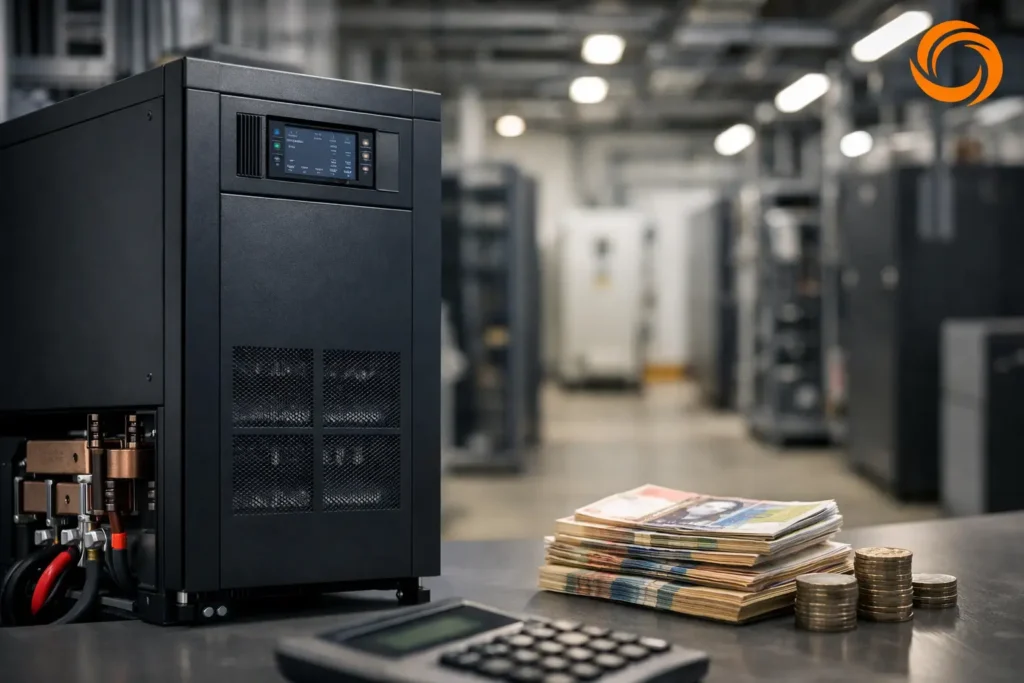
For a decision maker, the logic is straightforward: if a single power event can cause a costly failure, data loss, hours of downtime or reputational damage, the value of the UPS should not be measured only against the purchase price. It should be measured against the cost of the event it prevents. That is why serious projects treat UPS as an investment in business continuity rather than a line item in the electrical budget.
When BESS creates the biggest difference
BESS has the strongest business impact where a site has sharp demand peaks, variable tariffs, significant daytime consumption or on-site solar generation. In such cases the energy storage system can charge when power is cheaper or when solar produces excess energy, then discharge when energy is expensive or when demand peaks threaten to increase the bill and stress the grid connection.
This is especially relevant for manufacturing plants, logistics centers, cold storage facilities, commercial buildings with high HVAC loads, retail chains, campuses and industrial sites seeking greater energy independence. In those environments BESS is not just another battery. It is a tool that actively shapes the site’s energy profile.
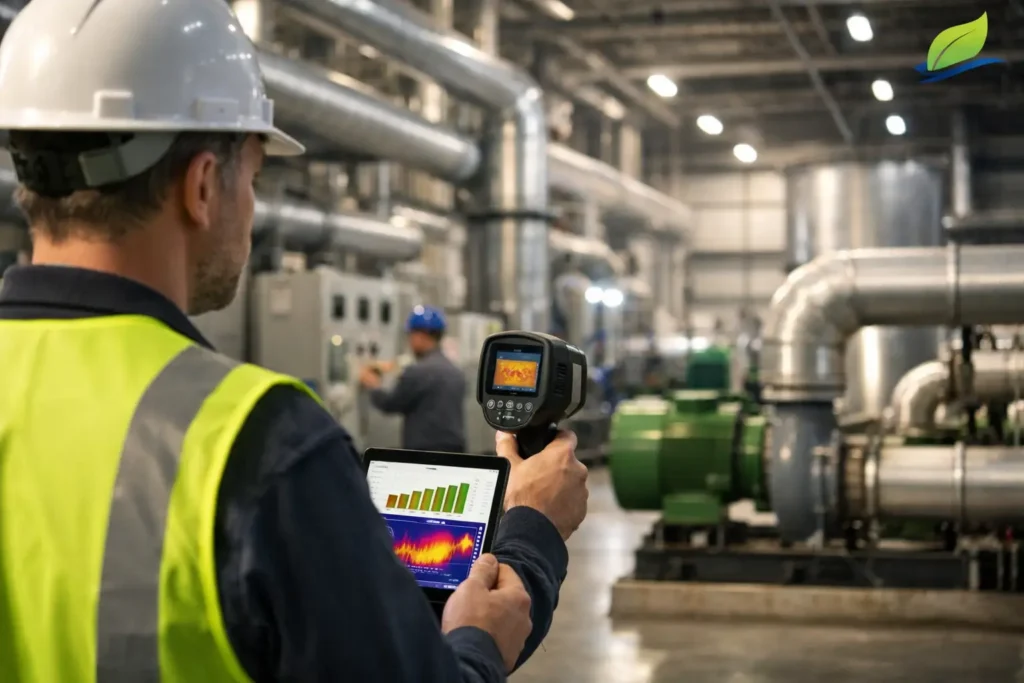
From a management perspective, BESS is often easiest to understand through three benefits. First, lower energy and demand costs. Second, better use of the solar investment. Third, greater resilience against an unstable grid and the possibility of supporting selected processes for longer than a conventional short-autonomy UPS could.
Why customers often need both
The biggest mistake is to frame these two systems as competitors. In real projects they are usually complementary. UPS handles the first and most sensitive moment with no interruption. BESS takes over the broader energy logic: how to run the site more intelligently, for longer and at lower cost.
A good example is a data center or a modern industrial plant. Critical IT equipment, automation and control systems require perfectly stable power and therefore remain on the UPS layer. But the same facility may also face high utility bills, demand peaks, backup generators, rooftop solar and the need for better energy management. This is where BESS adds a layer of value that UPS alone cannot provide.
The same applies in facilities with frequent short disturbances and occasional longer outages. UPS bridges the initial event and ensures that the process does not blink. BESS can extend available energy, optimize generator operation, reduce grid consumption and allow the site to be engineered more rationally instead of being sized only for the worst case. In that sense, a UPS + BESS combination is often more economical than forcing either system to perform a role it was not designed for.
Conclusion: the real question is not UPS or BESS, but how they work together
For most serious business users, UPS and BESS are not two versions of the same thing. They are two different answers to two different questions. The first question is: how do we make sure critical loads never lose high-quality power? The second is: how do we use energy more intelligently, more economically and with greater resilience?
Once those questions are framed correctly, the answer is very often a combined one. UPS remains the heart of continuity, while BESS becomes the brain of energy flexibility. Together they give the customer a system that not only survives disturbances but also actively improves business economics and operational resilience.
That is why the most mature investors today do not ask whether UPS is better than BESS or vice versa. They ask how their site can get the right measure of both.