A guide to understanding electricity consumption
Every month, we receive an electricity bill, check how much we need to pay, and usually put it aside. But have you ever wondered what all the numbers, tariffs and charges on it actually mean?
An electricity bill is more than a notice of how much money we owe. It contains useful information about our consumption, how charges are calculated, and costs that we can better understand, monitor, and in some cases reduce.
In this guide we explain how to read an electricity bill in Serbia, what the most important terms mean, and how to estimate how much electricity your home uses.
What is the most important information on your bill?
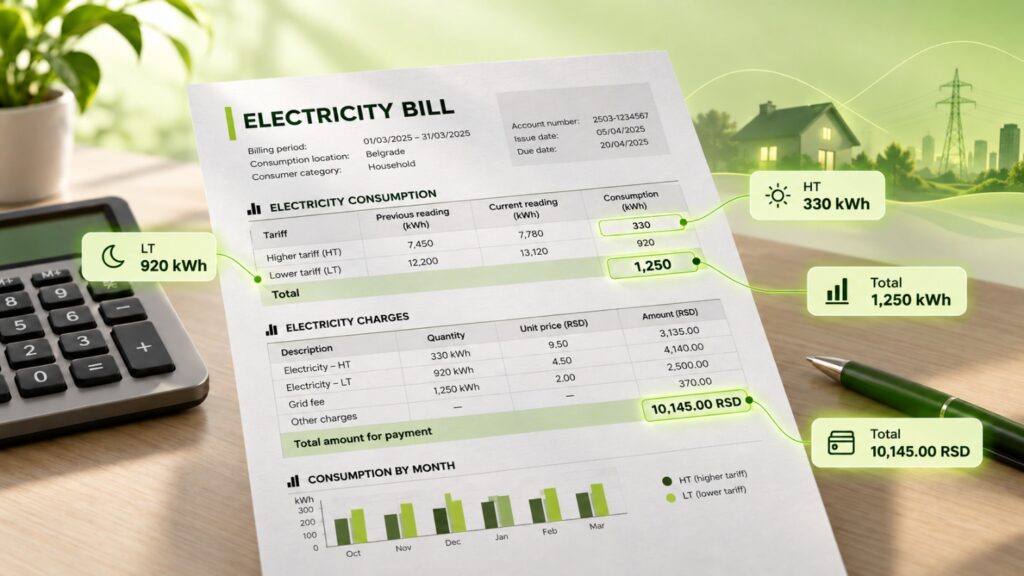
Although most people first look at the total amount due, the most important figure for understanding consumption is the amount expressed in kilowatt-hours (kWh). A kilowatt-hour is a unit of the amount of electrical energy you have consumed.
To put it simply:
1 kW × 1 h = 1 kWh – an appliance rated at 1,000 W, running at full power for one hour, consumes 1 kWh.
2 kW × 3 h = 6 kWh – an appliance rated at 2,000 W, running continuously for three hours, consumes 6 kWh.
10 W × 5 h = 0.05 kWh – a 10 W LED bulb left on for five hours consumes 0.05 kWh.
As a rule, the more powerful an appliance is and the longer it runs, the more electricity it consumes.
It is important to distinguish between two units: kW (kilowatt) measures an appliance’s power — the rate at which it uses energy at a given moment — while kWh (kilowatt-hour) measures the amount of electrical energy an appliance consumes over time.
If your bill shows a consumption of 690 kWh, it means that your household drew 690 kilowatt-hours of electrical energy from the grid during the billing period.
What are the higher and lower tariffs?
On many electricity bills in Serbia, consumption is divided into two tariffs:
Higher tariff (VT) – the period when electricity is billed at a higher price.
Lower tariff (NT) – the period when electricity is billed at a lower price; often called “off-peak electricity”.
For example, your bill may show the following:
Consumption type | Amount |
|---|---|
Higher tariff | 420 kWh |
Lower tariff | 180 kWh |
Total consumption | 600 kWh |
This means that 70% of your electricity was consumed at the higher tariff and 30% at the lower tariff.
Why does this matter?
Because the same amount of electricity does not necessarily cost the same under different tariffs. If you can safely use your water heater, washing machine or other appliances during the lower-tariff period, you may reduce your costs without reducing total consumption.
The exact hours of the lower tariff depend on the region and applicable tariff system. If you have a single-tariff meter, your consumption is not divided into higher and lower tariffs.
What do the green, blue and red consumption zones mean?
For households receiving regulated guaranteed electricity supply in Serbia, another important distinction applies — consumption zones. These zones determine the price charged for different portions of the electricity consumed.
For a 30-day billing period, under the rules in effect in October 2026, the thresholds are:
Zone | Monthly consumption |
|---|---|
Green | Up to 350 kWh |
Blue | Over 350 to 1,200 kWh |
Red | Over 1,200 kWh |
The green zone has the lowest electricity price, the blue zone has a higher price, and the red zone the highest.
Entering the blue or red zone does not mean that all consumed electricity is charged at the higher price.
For example, if you consumed 500 kWh over 30 days, the first 350 kWh are billed in the green zone, the remaining 150 kWh in the blue zone, and you have no consumption in the red zone. For billing periods longer or shorter than 30 days, the zone thresholds are adjusted proportionally.
Consumption zones should not be confused with the higher and lower tariffs. A zone depends on the total amount of electricity consumed, while a tariff depends on when it is used.
How is your monthly electricity consumption calculated?
Your bill may show both the previous and current meter readings. The difference between the two readings is the consumption for the billing period.
Suppose your meter shows a previous reading of 12,450 kWh and a current reading of 13,050 kWh. The difference is:
13,050 − 12,450 = 600 kWh
So, you consumed 600 kWh during that period. If you have a dual-tariff meter, the difference is calculated separately for the higher and lower tariffs and then the two amounts are added together.
Also check whether the bill is based on an actual meter reading or an estimate. If consumption was estimated, the next bill may contain an adjustment after an actual reading.
Why is the bill more than consumption multiplied by the electricity price?
One of the most common questions is: if I know how many kilowatt-hours I used and the price per kilowatt-hour, why is the total bill not simply the product of those two figures?
The reason is that an electricity bill includes several different charges. In addition to electricity itself, depending on the customer category and contract, your bill may include:
1. Charges related to billed power capacity
2. Fixed supply and metering-point charges
3. A levy supporting eligible electricity producers
4. An energy-efficiency improvement levy
5. Excise duty and value-added tax (VAT)
6. A public broadcasting fee – where applicable.
7. Outstanding balances or credits from previous billing periods.
This is why it is important to distinguish the cost of electricity from the total amount payable.
This distinction is particularly important when considering an investment in solar power. Reducing electricity drawn from the grid does not mean that every other charge automatically disappears.
What is billed power capacity?
You may also notice a billed power-capacity figure on your electricity bill, expressed in kilowatts (kW). Unlike consumption in kWh, power indicates the size of the electrical load.
For households, the power charge is generally based on the approved connection capacity and the applicable tariff rules.
How can you calculate annual consumption from your bills?
If you want to understand how much electricity you actually use, one monthly bill does not give the full picture. It is best to collect your bills for the last 12 months.
Period | Consumption |
|---|---|
January–March | 2,100 kWh |
April–June | 1,500 kWh |
July–September | 1,800 kWh |
October–December | 2,400 kWh |
Annual total | 7,800 kWh |
In this example, the household consumes 7,800 kWh of electricity per year. Average monthly consumption:
7,800 kWh ÷ 12 = 650 kWh/month
However, actual consumption will not necessarily be the same every month. It may rise in winter due to electric heating and in summer due to air conditioning. This is why it is important to look at the entire year. Annual consumption is one of the basic inputs for an initial assessment of the financial viability of a solar PV system.
What can your bill tell you about potential savings?
Your electricity bill is the starting point for understanding your electricity costs. From it, you can determine:
1. How much electricity you consume monthly and annually
2. How much of your consumption falls under the higher and lower tariffs
3. Whether there are significant seasonal variations during the year
4. How much you pay for electricity drawn from the grid
5. Which additional charges affect your total bill
6. Whether your consumption is rising or falling compared with previous periods.
However, there is one important thing that a bill alone usually cannot show:
Your bill tells you how much electricity you consume, but not the hours of the day when you used it.
Why does this matter?
Imagine two households that each consume 7,800 kWh per year. The first household uses most of its electricity during the day, when air conditioning, household appliances and other devices are running. The second household uses most of its electricity in the evening and at night.
Although their annual consumption is identical, their ability to use electricity generated by solar panels directly may differ.
Solar panels generate electricity during daylight hours, so knowing when electricity is consumed is very important for assessing their economic value.
A more detailed analysis may require data from a smart meter or an additional consumption-monitoring system.
Can the required size of a solar PV system be determined from an electricity bill?
An electricity bill is an excellent starting point, but it is not sufficient to choose the final size of a solar PV system. A proper assessment needs to be considered:
1. Annual electricity consumption
2. Daily and seasonal consumption patterns
3. Roof area, orientation and condition
4. Potential shading during the day
5. Grid-connection options and technical constraints
6. Planned changes in electricity use – such as installing a heat pump or purchasing an electric vehicle.
A household consuming 7,800 kWh annually may be a good candidate for solar power, but that does not mean the required system size can be determined by dividing annual consumption by a single number.
It is necessary to estimate how much electricity the system would generate, how much would be used immediately on-site, and how much, if any, would be exported to the grid. Only after such an analysis is it possible to provide a responsible estimate of savings and return on investment.
Five things to check on your next electricity bill
The next time you receive your electricity bill, do not look only at the amount due. Start by checking:
1. Total consumption in kWh – how much electricity did you use during the billing period?
2. Higher and lower tariffs – when do you use more electricity?
3. Consumption zones – does any of your usage fall into the more expensive zones?
4. Comparison with previous periods – has consumption increased, and can you explain why?
5. Additional charges – how much of the total bill comes from items other than the price of active energy?
After just a few months of tracking these figures, you will have a much clearer picture of how you use electricity.
Conclusion: understanding consumption is the first step toward a lower bill
You do not need to buy new equipment or change your lifestyle immediately to reduce electricity costs. Start with what you already have — your electricity bill.
Understanding consumption, tariffs and billing methods allows you to distinguish genuine savings opportunities from assumptions. If you are considering solar power, bills from the past 12 months are an excellent place to start.
ENERGIZE offers a free initial solar feasibility assessment that considers your electricity consumption, the characteristics of your property, and the potential to generate electricity for your own use. The goal is not to recommend the largest possible solar system, but a solution that meets your actual needs.
ENERGIZE – Free solar feasibility assessment
ENERGIZE develops and delivers turnkey solar PV systems for households, commercial and industrial facilities. The feasibility assessment starts with your bill and annual consumption and ends with an estimate of expected production and indicative payback for your property.
Would you like to know whether solar power makes financial sense for your property?
Contact the ENERGIZE team and request a free feasibility assessment based on your electricity bill and annual consumption.
 | ENERGIZE d.o.o. Beograd prodaja@energize.rs 011 4055 264 |