Technical Parameters and Application
During the design and execution of works on residential, commercial, or industrial facilities, the proper selection of electrical installation materials is the foundation of long-term safety and functionality. Power cables are a key infrastructure element that ensures stable energy transmission and the safety of the entire system. An inadequate choice of conductors can lead to serious technical problems, operational downtime, and high remediation costs.
Characteristics of Conductor Materials
The basic classification of conductors refers to the type of material, with copper and aluminum being the most commonly used. In almost all indoor installations, copper represents the standard and optimal choice due to its high conductivity, elasticity, and resistance to mechanical damage. Aluminum conductors are predominantly used for large supply lines, such as those connecting the distribution grid to main switchgear facilities, primarily due to their lower specific mass and economic viability over long distances.
Cable Classification According to Environmental Conditions
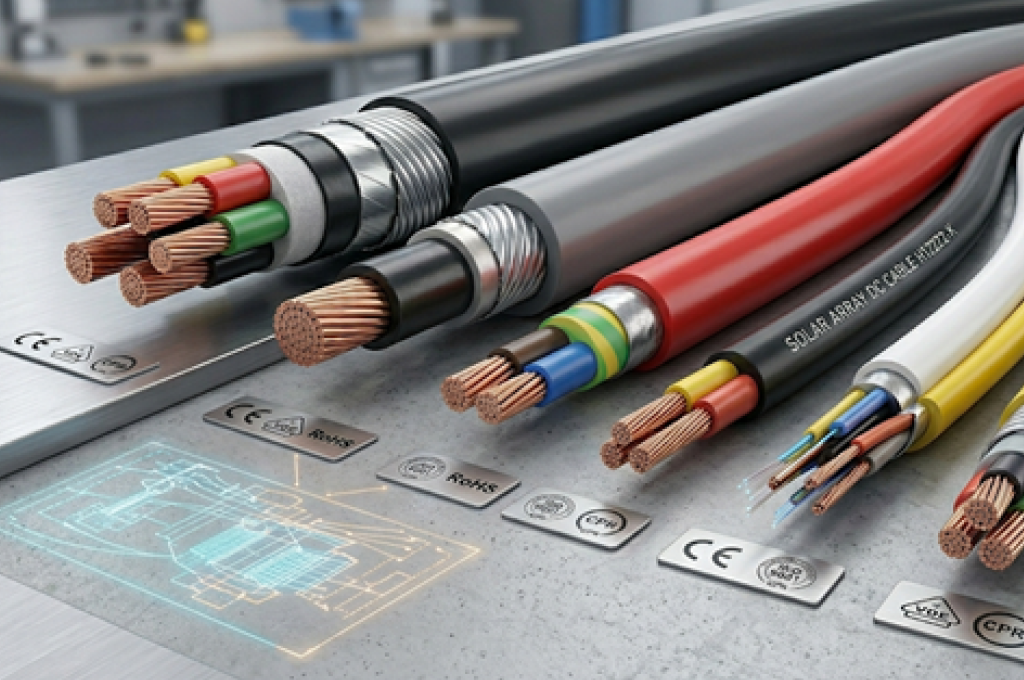
Proper cable specification directly depends on its installation location and the intended operating conditions. For standard indoor installations, laying in walls, installation conduits, or plaster, a PP-Y (NYM) type cable is standardly used. When it comes to outdoor use, underground laying, or operating in wet and mechanically demanding conditions, a PP00 (NYY) type cable is applied, which features additional protective insulation resistant to external influences. In public facilities, commercial buildings, and areas with high human traffic, safety standards strictly mandate the use of halogen-free cables (LSZH). These cables are designed so that, in the event of a fire, they do not emit toxic gases and thick smoke, thereby ensuring safe conditions for evacuation and the protection of people.
Sizing of Conductor Cross-Section
Adequate sizing of the cable cross-section is crucial for preventing overheating and ensuring a stable power supply to consumers, and the calculation itself depends on the installed power of the devices. In standard installations, conductors with a cross-section of 1.5 mm² are primarily used for lighting circuits. A cross-section of 2.5 mm² is applied to power standard sockets and average-consumption devices. For higher-power consumers, such as air conditioning systems, heat pumps, or industrial machines, the use of conductors with a cross-section of 4.0 to 6.0 mm², or even more, is necessary, depending on the specific load. Physically speaking, a high-quality cable is characterized by a clearly centered conductor within the insulation, which must be of uniform thickness along its entire length.
Impact of Route Length and Voltage Drop
When designing installations over longer distances, it is of great importance to calculate the voltage drop. By increasing the length of the cable route, the electrical resistance increases proportionally, resulting in a voltage drop at the end of the line. In order to protect process equipment, servers, and electric motors from premature failure due to operating at reduced voltage, it is recommended to adopt a conductor cross-section for long routes that is one step larger than the minimum calculated for that specific load.
Quality Check and Material Compliance
Before installing materials on the construction site, it is mandatory to check the declaration and markings on the product itself to avoid using equipment that does not meet the prescribed standards. A high-quality cable must contain clearly imprinted data along its entire length, including the manufacturer’s name, exact cable type, number and cross-section of the cores, as well as the CE mark, which confirms compliance with European quality and safety norms.
Conclusion
Investing in high-quality electrical installation materials represents long-term security for every project. Whether it involves commercial buildings, large residential complexes, industrial plants, or solar power plants, the proper sizing and selection of certified cables guarantee the reliability and safety of the entire system. An expert approach in this phase of design and construction ensures a stable power supply, continuity of work processes, and complete infrastructural protection of the facility throughout its entire lifespan.