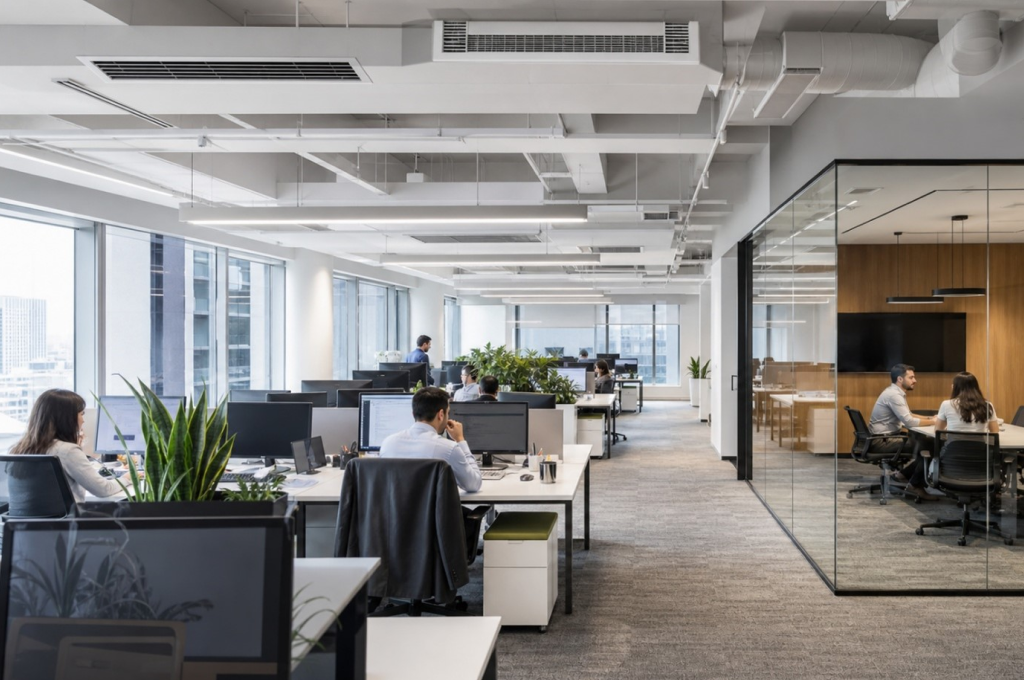
In offices, HVAC directly affects the working atmosphere. When temperature is unstable, the air is stale, or the system is noisy, employees notice it quickly. A business space does not need to be technically complex for HVAC to matter; it is enough that several people spend eight hours a day inside it.
That is why office HVAC should not be treated only as a building cost, but as part of working conditions. A good system supports concentration, reduces user complaints, and helps the space function predictably throughout the day.
Offices have changing loads
Office spaces rarely follow the same rhythm all day. The space fills up in the morning, meeting rooms are used during the day, some areas are more active than others, and the number of people changes. Computers, lighting, and equipment also add heat to the space.
That is why HVAC that operates according to one fixed logic often does not deliver a good result. Open workspaces, management offices, meeting rooms, kitchens, and corridors have different needs. A meeting room can become stuffy quickly without sufficient ventilation, while an open area may have uneven temperatures due to large glass surfaces.
Zoning and controlled ventilation have high value here. The space does not need the same operating mode everywhere, especially when some zones are used only occasionally.
Air quality affects the working day
In offices, air quality is often noticed only once it becomes poor. Employees feel fatigue, weaker concentration, headaches, or the need to constantly open windows. People spend around 90% of their time indoors, so ventilation should not be a secondary item.
A good office HVAC system should provide stable temperature, enough fresh air, filtration, and quiet air distribution. Noise is especially important because a system that constantly disturbs work quickly becomes a problem, even if it heats or cools effectively.
In modern offices, sensors, smart thermostats, and centralized control play an increasing role. They allow energy use to adapt to occupancy instead of making the whole building run at the same intensity all day.
Efficiency is visible through daily operation
Office HVAC often runs for long hours, five or more days a week. That means a small difference in efficiency becomes a significant cost difference over time. Well-adjusted controls can reduce annual heating and cooling costs by up to 10%, while more advanced management further reduces unnecessary consumption in empty zones.
Maintenance is especially important in commercial spaces. Dirty filters, poorly balanced airflow, and faulty sensors can reduce air quality and increase consumption. A system that is not maintained becomes more expensive, noisier, and less reliable over time.
What a good choice should provide
Office HVAC should be quiet, flexible, and easy to manage. In smaller spaces, this can mean a well-selected split or multi-split system with good ventilation. In larger offices, VRF/VRV systems, heat recovery, zoning, and central monitoring are more often considered.
The best solution depends on layout, number of people, working hours, and the way the space is used. In offices, HVAC is valued through stability: fewer complaints, fewer manual adjustments, better air, and lower operating costs.
A good business space does not draw attention to air conditioning, noise, or stuffiness. It allows people to work without constantly feeling that indoor conditions are getting in the way. That is the greatest value of a properly selected HVAC solution for offices.