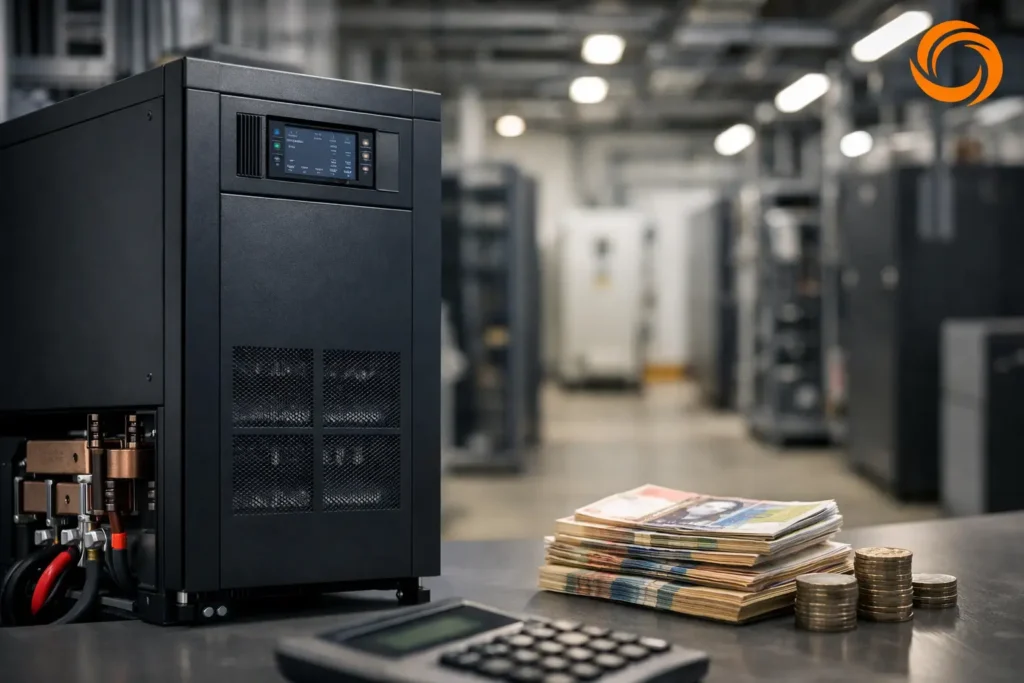

In modern business, electricity is no longer just an operational resource – it is the foundation of business continuity. When a power outage occurs, the consequences are not measured only in minutes of inactivity, but in direct financial losses, reputational damage, and long-term business impact. One key question every company should ask is: how much does one hour of downtime really cost?
Cost of Downtime Across Industries
The cost of one hour without power varies significantly depending on the industry, but the common denominator is clear – losses are always higher than expected.
In IT environments and data centers, even a few seconds of downtime can cause serious disruption. Data loss, server interruption, and application unavailability directly affect users and revenue. Estimates show that one hour of downtime in larger data centers can cost anywhere from tens of thousands to hundreds of thousands of euros.
In addition to direct revenue loss, companies also face: loss of customer trust, contractual penalties and additional recovery costs.
In manufacturing, downtime means a complete halt of production lines. This includes idle workforce costs, spoilage of raw materials or semi-finished goods and additional restart costs (which often require additional time and resources).
In certain industries (e.g., food processing, chemical production), one hour of downtime can result in losses ranging from thousands to tens of thousands of euros, along with potential equipment or product damage.
In hospitals and medical facilities, downtime is not just about money. Power interruptions can directly endanger patient lives.
Costs include interruption of medical equipment, loss of critical data but most critical is considered as major risks to patient safety.
Here, power reliability is an absolute priority, and the cost of downtime is practically immeasurable.
Banks, stock exchanges, and financial institutions depend on continuous system availability. Any interruption can mean inability to process transactions, financial losses due to missed opportunities and significant regulatory penalties.
In this sector, one hour of downtime can easily reach hundreds of thousands of euros.
Telecom operators and digital platforms must operate 24/7. Downtime results in service interruptions, customer loss and revenue decline.
Even short outages can trigger a domino effect impacting a large number of users.
Hidden Costs of Downtime
Beyond direct financial losses, there are also indirect costs: reputational damage and loss of trust, system recovery expenses, decreased productivity and at the end, long-term customer churn.
For this reason, the real cost of one hour of downtime is often several times higher than the immediate financial loss.
The Solution: UPS Systems as a Guarantee of Continuity
The only reliable way to eliminate or minimize the impact of power outages is through the implementation of UPS systems.
A UPS provides instant backup power with zero interruption, stable and clean output voltage, protection for sensitive equipment and it enables sufficient time for safe shutdown or continued operation.
Modern business systems require flexibility, scalability, and maximum reliability. This is why modular UPS systems represent the most advanced solution available.
Modular UPS systems offer:
Scalability: The system can expand as business needs grow, without large upfront investments.
High Reliability: Support for redundancy configurations (N+1, N+X, 2N) ensures that a single module failure does not impact system operation.
Easy Maintenance: Hot-swappable modules allow replacement without downtime.
High Efficiency: Up to 96.5% efficiency in online mode and up to 99% in ECO mode reduce operational costs.
One of the key advantages of modern UPS systems is output Power Factor (PF) 1.0
This means that active power available for equipment is 100%. There are no losses between kVA and kW, and this UPS system provides maximum system efficiency.
For users, this translates directly into more usable power from the same system and a better return on investment.
Conclusion
When all factors are considered, one hour of downtime can cost anywhere from a few thousand to hundreds of thousands of euros—and in some industries, much more. More importantly, the consequences often go beyond financial loss, affecting reputation, safety, and long-term business viability.
In this context, investing in a high-quality UPS system is not an expense—it is a strategic decision. Modular UPS systems, with their flexibility, reliability, and efficiency (especially with PF 1.0), represent the ideal solution for companies that demand uninterrupted operation.
In simple terms – the cost of downtime is high. The cost of preventing it is significantly lower.