When a company reaches the point where it needs its own transformer substation, the first question is always the same: how much does it cost?
The answer most commonly heard – “it depends” – is correct, but not particularly helpful. It is far more useful to understand what makes up the price, because that makes it easier to see where optimisation is possible and where cutting costs can create expensive problems.
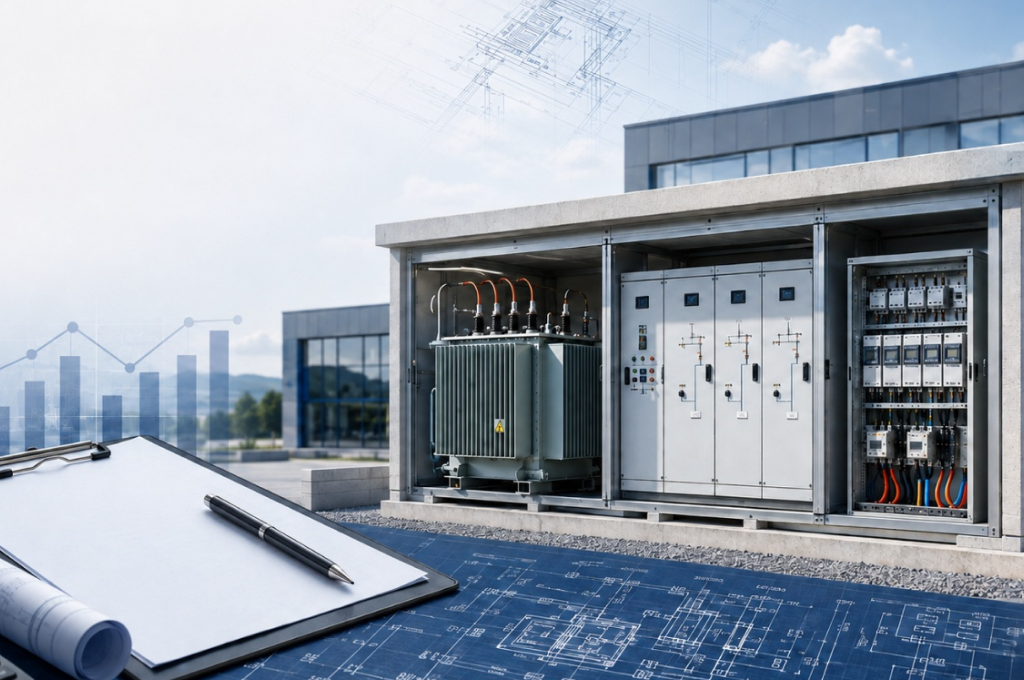
A transformer substation is not a single product, but a system consisting of several major components.
The first is the power transformer, usually the largest individual cost item. Its price depends on its rated power, type, energy losses and delivery time.
The second is the medium-voltage switchgear, consisting of cells equipped with circuit breakers, disconnectors and protection systems. The number and type of cells depend directly on the selected power supply configuration.
The third component is the low-voltage distribution system, including the main circuit breaker, outgoing feeders and metering equipment.
The fourth is the enclosure, which may be made of concrete, metal or constructed as a masonry building, together with the foundations and earthworks.
The fifth component includes medium and low-voltage cable connections, grounding and lightning protection systems.
In addition to the equipment itself, there are several costs that are often overlooked in quotations: design documentation, approvals and permits, grid connection costs charged by the distribution system operator, testing, certificates and final handover.
For higher connection capacities, the grid connection fee can be comparable to the cost of the equipment itself. Planning the budget without taking this cost into account can therefore be a serious mistake.
Two quotations for what appears to be the same transformer substation can differ by as much as one third, without either quotation necessarily being incorrect.
The difference usually lies in the equipment specification: the transformer loss class, the type and manufacturer of the medium-voltage switchgear, the level of automation and remote monitoring, the quality of the low-voltage equipment and the scope of civil works.
A cheaper option on paper often means higher energy losses and more expensive maintenance over thirty years of operation. Comparing quotations solely on the basis of price can therefore result in choosing the more expensive solution in the long term.
As a general indication, a complete compact transformer substation for typical industrial power requirements, including equipment, civil works and commissioning, starts at several tens of thousands of euros.
Once grid connection fees and cable routes are included, the total project cost will generally exceed this initial figure.
Any reliable estimate requires specific input data: the required capacity today and in five years, the grid connection point, the length of the cable routes and the requirements of the distribution system operator.
For this reason, the first step should always be an analysis of electricity consumption and site conditions, followed by the equipment specification.
A practical process looks like this: analyse consumption and peak load, define the required capacity with sufficient reserve for future growth, obtain the distribution system operator’s connection conditions and only then request quotations based on a clearly defined equipment specification.
When all suppliers are quoting against the same specification, the offers become genuinely comparable and the investor is no longer comparing apples with oranges.
A transformer substation is built once every few decades, which makes several weeks of careful preparation the least expensive part of the entire project.