The Invisible Cost Eating Your Margins
When you buy a UPS, the specification says “efficiency 96%.” At first glance, that sounds excellent — almost all the power reaches your load. But what happens with the remaining 4%? It turns into heat. And that heat isn’t free.
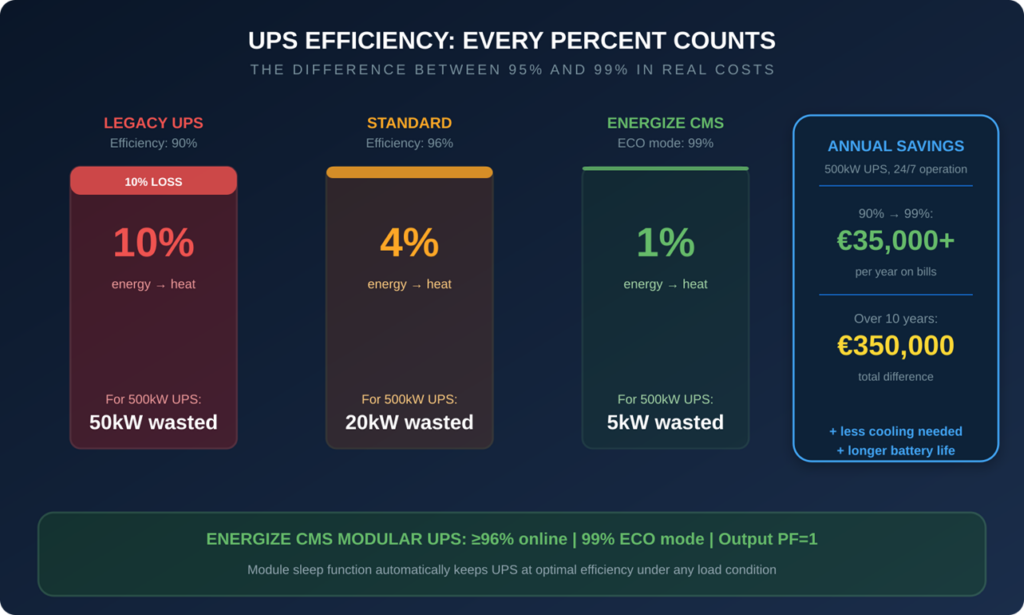
For an industrial 500 kW UPS running 24 hours a day, 365 days a year, the difference between 90% and 99% efficiency isn’t an academic question. That’s a difference of 45 kW of continuous loss — energy you pay for but never use. Annually, that’s over 394,000 kWh of wasted electricity. At average industrial electricity prices in Serbia, we’re talking about approximately €35,000 in pure losses — every year.
Over a UPS lifecycle of 10–15 years, an inefficient system can “eat” more money in consumption than the device itself cost.
Operating Modes: Where Efficiency Is Won and Lost
Every UPS has several operating modes, and each carries a different efficiency level.
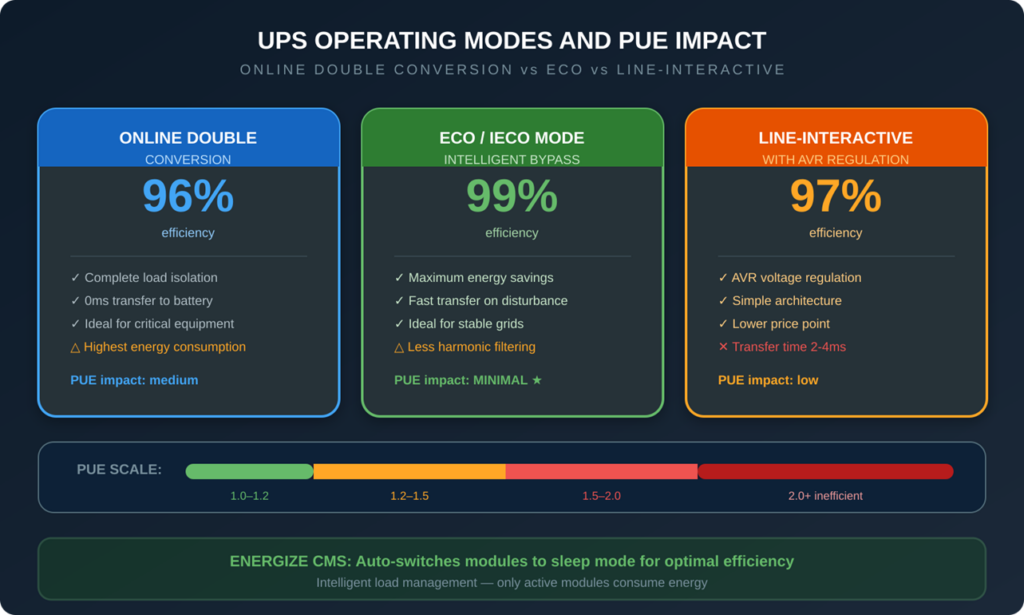
Online double conversion is the “gold standard” of protection. The UPS continuously converts mains power from AC to DC, then back to AC. The load never directly touches the grid, meaning complete isolation from all disturbances — harmonics, voltage sags, surges. The cost of this protection is efficiency typically ranging between 94% and 96%. Energize CMS modular systems achieve 96% and above in this mode, placing them at the very top of the category.
ECO mode (or IECO — Intelligent ECO) is a mode where the UPS passes mains power directly to the load but stands ready to take over within milliseconds if a disturbance occurs. Efficiency in this mode can reach 99%. This is ideal for environments where the grid is relatively stable but protection against complete outages remains essential.
The Energize CMS series additionally features a module sleep function — when the load is low, unnecessary modules automatically shut down while the remainder operates in the optimal efficiency zone. Instead of five modules running at 30% capacity each (where efficiency is low), two modules run at 75% (where efficiency peaks) while the others stand by.
PUE: The Metric That Reveals Hidden Costs
In the data center world, PUE (Power Usage Effectiveness) is the holy grail of metrics. It’s calculated as total energy entering the facility divided by the energy actually powering IT equipment. Perfect PUE is 1.0 — meaning every watt goes to computing. In practice, values below 1.3 are considered excellent.
The UPS is one of the largest “contributors” to high PUE. An inefficient UPS not only wastes energy directly but produces heat that requires additional cooling, further increasing PUE.
Upgrading from a 90% efficient UPS to a 96% system in a 500 kW data center can reduce PUE by 0.1–0.15 points. At first glance, that’s a small number. But on the annual electricity bill, it can mean a difference of €20,000–40,000, depending on location and energy prices.
For industrial facilities that don’t use PUE as a formal metric, the equivalent is straightforward: how many kilowatts are you “throwing away” through UPS inefficiency, and how much is the additional cooling costing you?
Output Power Factor: The Hidden Multiplier
Most older UPS systems have an output power factor (PF) of 0.8 or 0.9. This means a 100 kVA UPS can actually deliver only 80 kW or 90 kW of real power. The remainder is reactive power performing no useful work.
Modern modular UPS systems, including the Energize CMS series, have an output PF of 1.0. This means 100 kVA delivers a full 100 kW. In practice, this means you need a smaller (cheaper) UPS for the same load, or the same UPS can power more equipment.
For factories sizing a new UPS, the difference between PF 0.8 and PF 1.0 can mean a 20% smaller system for the same protection. Those are direct savings on purchase, installation, and ongoing consumption.
Practical Example: Savings Over 10 Years
Let’s take a concrete scenario: a factory with a critical load of 300 kW, operating continuously. An old UPS with 90% efficiency wastes 33 kW on its own losses alone. A modern modular UPS with 96% efficiency in online mode wastes 12.5 kW. In ECO mode at 99% efficiency, losses drop to just 3 kW.
The difference between old and new systems: approximately 20 kW continuously, which is 175,000 kWh annually. At €0.09/kWh, that’s savings of approximately €15,750 per year, or around €157,000 over 10 years — on electricity alone. Add reduced cooling costs, and total savings easily exceed €200,000.
And this doesn’t account for the value of avoided downtime, which is difficult to quantify but in industry often exceeds all other costs combined.
What to Watch for When Choosing
When selecting a UPS, paper efficiency and real-world efficiency aren’t the same thing. A manufacturer may state 96% efficiency, but that’s typically at full load. In reality, most UPS systems run at 40–70% capacity, where efficiency can be significantly lower.
The key question therefore is: what is the efficiency at partial load? Modular systems hold a massive advantage here because they automatically adjust the number of active modules to the current load, keeping each module in the optimal zone.
Also, pay attention to input power factor. A UPS with high input PF (≥0.99, as with the Energize CMS series) draws less current from the grid for the same useful power, meaning less stress on cabling, distribution panels, and transformers.
Conclusion: Efficiency Is an Investment, Not an Expense
In a world where energy prices are steadily rising and regulatory requirements for energy efficiency are becoming increasingly stringent, a high-efficiency UPS isn’t a luxury. It’s one of the smartest investments an industrial manager can make.