

This is probably the most common question homeowners ask when they first start seriously thinking about solar panels. And that makes perfect sense. Most people are not interested in solar as a technology on its own, but as a very practical decision that should affect the household budget. Precisely for that reason, this topic deserves an honest and realistic answer. Solar can significantly change the electricity bill in a family home, but not by magically erasing energy costs overnight. The real benefit becomes visible once you understand how the household consumes electricity, when it consumes it, and how solar fits into that rhythm.
The first thing to say is that solar does not work the same way for every house. Two homes can have very similar roofs and end up with very different outcomes on the electricity bill. The reason is simple: the bill is not determined only by the panels, but also by consumption habits. A house where people are home during the day, where air conditioning, a boiler, a pool, a heat pump, or a home office are active, has a very different load profile from a house that is empty most of the day and where most electricity is used in the evening. Solar works best when a large share of what it produces is consumed directly in the home.
That is why it is often more useful to ask not “how many panels can I install,” but “when does my house actually use electricity?” This is where a realistic estimate of bill reduction begins. If a household already has substantial daytime consumption, solar directly reduces the amount of electricity that would otherwise be bought from the grid. If consumption is mainly concentrated in the evening, there is still value, but the billing logic and seasonality become more important. For household consumer-producers, EPS uses a net metering model, where billing is based on the difference between imported and exported energy, which is why the bill has to be seen as a system and not just as a snapshot of one sunny hour.
A second important point is that solar does not only influence one summer bill. It changes the way energy costs are distributed across the year. Production is stronger in summer and lower in winter. That means that a house with solar often experiences a much smoother relationship between high- and low-cost seasons than a house without panels. People sometimes expect the bill to become minimal every single month, but it is much more realistic to look at the annual effect. Solar changes the structure of the cost: part of the energy that used to be purchased from the grid is now coming from the roof, and this becomes especially visible in months with longer, sunnier days.
A third effect is that the real change is not only about lower amounts, but about greater predictability. When part of your electricity consumption is covered by your own production, you are less exposed to future price shifts and less dependent on how much extra daytime use will push up the bill. That matters especially for households planning new electric loads: a heat pump, additional air conditioners, electric vehicle charging, or some other form of home electrification. In that case, solar does not simply reduce the old bill. It makes it easier to add new comfort without creating an equally large new energy burden.
Of course, that does not mean solar solves everything on its own. If a house has poor insulation, an inefficient heating system, and very irrational energy use, panels will not automatically erase all of those weaknesses. This is why the best results usually come when solar is seen as part of a wider picture. A family home that is reasonably energy efficient, with a clear consumption profile and a properly sized system, can get far more value from solar than a house where the expectation is that the panels will fix every other issue by themselves.
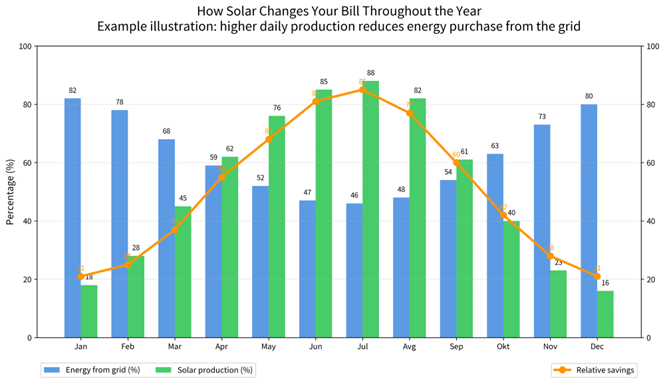
Illustration: family home and the core logic of a residential solar system.
The bill is not the only proof of efficiency
Another common misunderstanding is that the bill is the only meaningful indicator of value. In practice, many homeowners discover after installation that solar changes their behavior as well. They start shifting certain uses into daytime hours, become more aware of how much the house consumes, and find it easier to plan future energy investments. That is an interesting effect because solar does not only change numbers on a bill. It changes the household’s relationship with energy.
Subsidies also affect how people see the bill and the payback of the investment. Programs supported by the state and municipalities can reduce the initial cost of a project, which in turn improves the financial picture. By late 2025, Serbia’s Ministry of Mining and Energy was still pointing out that energy renovation programs can cover a meaningful share of household investment costs, depending on the package of measures. For a family home, that means the electricity bill should not be viewed separately from the initial capital cost: when the entry cost drops, the overall case becomes more attractive.
For a family home, the most realistic answer sounds like this: solar can significantly reduce the electricity bill, but the result depends on four things. First, the household’s consumption. Second, when that consumption happens. Third, the quality of the design and the sizing of the system. Fourth, whether the investment is seen over the long term and not only through the lens of next month’s bill. When those four elements are aligned, solar can deliver both visible savings and a much stronger sense of control over costs.
Another important point is that solar does not have the same impact on every type of user. A household with a stable daytime base load can usually absorb rooftop generation more effectively. By contrast, a household that consumes most of its electricity late in the evening needs to think more carefully about system size and usage habits. That does not mean only one scenario makes sense. It simply means that the answer comes from real consumption patterns, not from generic claims.
This is why the best solar projects are built around data rather than slogans. Historic bills, plans for the house, roof characteristics, shading, and the family’s expectations matter more than any universal promise. Once those elements are brought together, the electricity bill starts changing in a real and sustainable way, and the homeowner gets a much clearer picture of what exactly they are buying and why it fits their home.
Perhaps the best conclusion is this: solar does not change the bill by “eliminating” it, but by changing the logic of the house. The home no longer depends entirely on buying electricity from the grid. Part of the load shifts to self-generation. That changes monthly costs, seasonal patterns, long-term planning, and the household’s energy resilience. In that sense, the real effect of solar on the bill is broader than a single number at the bottom of an invoice. It can make a home more efficient, more rational, and better prepared for the years ahead.